
Hills4ATL builds community at Piedmont Park, one hill at a time
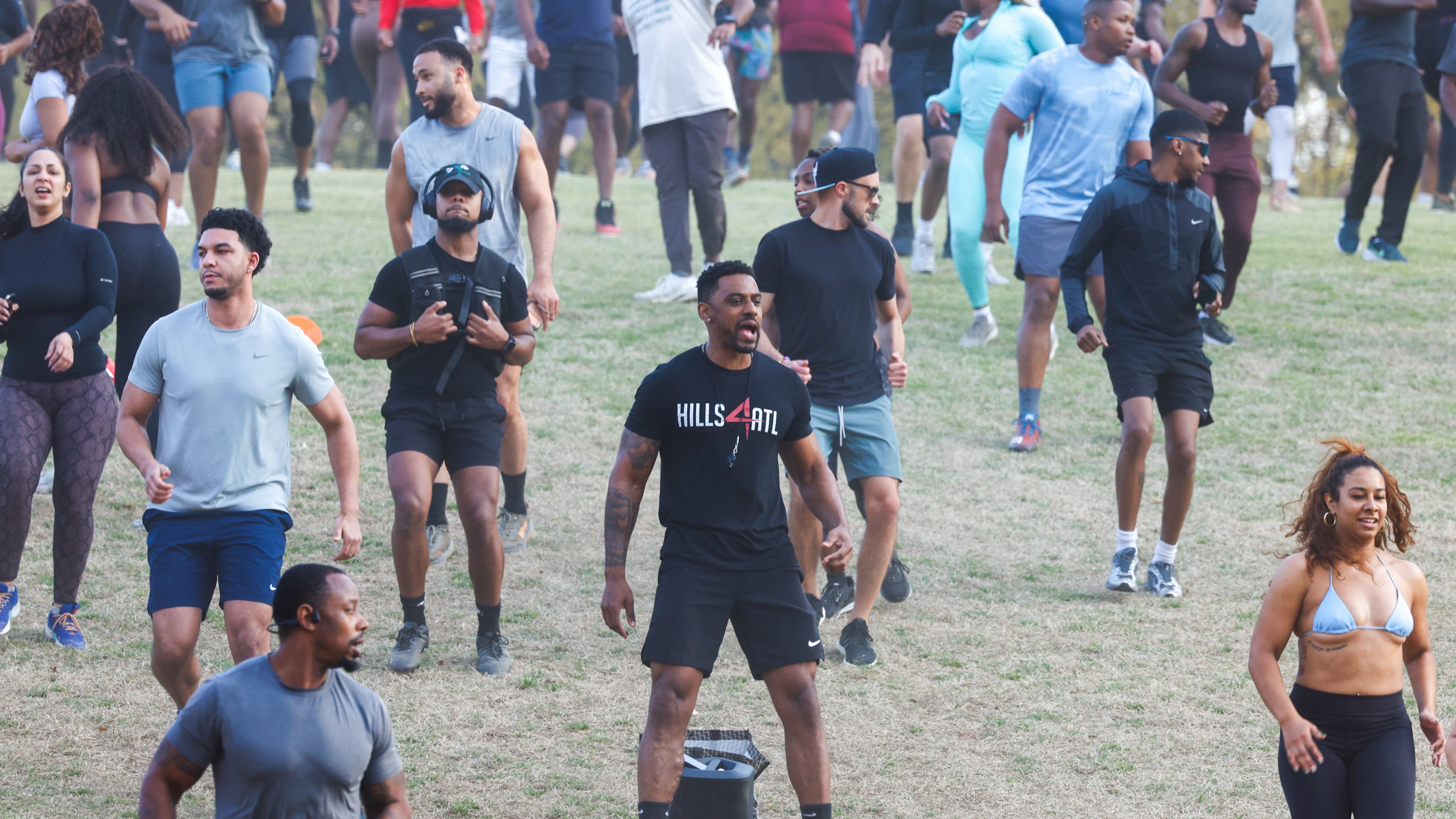
Every Wednesday, Alvin Bailey gets to Piedmont Park at around 5 p.m. His stop is at the base of Oak Hill, a wide, grassy incline rising gently from the park’s eastern edge, near the intersection of 10th Street and Charles Allen Drive.
Quietly, he walks up and down the hill, strategically placing cones and markers. As he begins to test his sound system, people slowly gather at the bottom of the hill — stretching, hydrating, chatting.
By 6:30 p.m., more than 300 people are standing in front of Bailey, now positioned midway up the hill.
“All right,” Bailey says. “Let’s get ready to work.”

He blows his whistle, and a third of the group surges forward, charging up the hill. Another wave follows. Then another.
Within minutes, Oak Hill is in motion — a steady rhythm of bodies climbing, descending, pushing.
From the outside, it looks like a workout.
Up close, for the next hour, it becomes something more: This is Hills4ATL.
“First and foremost, it’s community,” said Aiyana Cristal, 42, who found Hills4ATL after years of searching for something similar. “Not growing up in Georgia and being a transplant to Atlanta, it’s often hard to find these types of communities. I need this.”

Cristal is not alone. For many on the hill, the draw is the same — a place to connect and to belong.
Bailey — known on the hill as AB — needed it too.
A reset on the streets of Atlanta
A 40-year-old native of Knoxville, Tennessee, Bailey moved to Atlanta during the pandemic to care for his mother after stints in New York City and Miami, where he worked as a deejay.
He had always been physically active, but began to feel sluggish.
So he started jogging through the streets of Atlanta.
Until he got hit by a car.
The April 2020 accident, captured on surveillance cameras, was violent. He didn’t break any bones, but it took months to heal not only from the bruises and scars, but also emotionally.
It broke his rhythm. It forced stillness.
“It made me reset,” he said, adding that in that pause, an idea began to take shape.

He found parks to work out in — where he could move freely and safely — and started inviting others to join him.
As a deejay and son of a community organizer, he always had a knack for bringing people together.
“My mom was a Girl Scout leader, so I’ve been around community my whole life,” Bailey said. “As I got older, I wanted to do something similar, something that gave me that same fulfillment that she exposed me to.”
The first workouts in 2021 were small. A few friends. Then a few more. No branding. No celebrities. No plan. Just consistency.
He showed up, and eventually, others did too.

“It went from three people to five, to 10, to 20,” Bailey said. “I still remember our first 100-person class.”
What Bailey was building spread organically — person to person, friend to friend, body to body.
“Just everyday people bringing their friends,” Bailey said. “We’ve had up to 550–600 people. It’s been amazing to watch it grow.”
From a few friends to a few hundred
Today, fueled largely by social media, Hills4ATL has grown into something far bigger than a weekly workout.
The popular Wednesday night session follows an early morning class that draws its own crowd. On Mondays, at Historic Fourth Ward Park, Bailey leads “One Step at a Time,” where participants run up and down the park’s steps.
The programming continues throughout the week, with high-intensity training sessions at a new indoor facility along the Atlanta BeltLine on Thursdays and yoga and the Mile Crusher on Saturdays.
The workouts remain free — a cornerstone of Bailey’s approach — though a paid membership tier offers access to social events like skate parties, game nights and movie nights.

“I never thought it would grow this big,” said Bailey, who now manages Hills4ATL full time. “That wasn’t the goal. I just wanted to make an impact and serve my community. I didn’t want to turn anybody away.”
Finding community on the hill
On a recent Wednesday, Shynethia Canty, a 43-year-old natural hairstylist, stood at the base of the hill, quietly stretching. It was her first time, after being invited by her co-worker, Tatiana Smith, a regular.
She glanced up at Oak Hill and admitted it looked intense.
“I decided to come because I wanted to be outdoors, have fun and meet other Black men and women,” said Canty, who moved to Atlanta from Savannah. “Networking and building community are important to me. It helps us understand how we think and what we’re going through. This feels like a congregation — uplifting and educating people.”

Reflection of a city
Bailey has never targeted Hills4ATL to a specific group, but on any given night, the crowd reflects a distinctly Black experience, with most participants appearing to be African American.
Still, others fit in seamlessly — Hispanic, Asian, and white participants, members of the LGBTQ community, and people with disabilities.
Children and teenagers dart through the crowd, alongside participants in their 60s and 70s. T-shirts representing HBCUs are everywhere.
Women in Greek sorority shirts are abundant, as are men representing fraternities — except the Ques, who, as usual, are shirtless.

There are novices, weekend warriors, former college athletes, retired pros and even former Olympians, all tackling the hill.
“Community, for us, is anyone who wants to be included,” Bailey said. “We have people from 6 to 80 years old. Every race, every background. That’s what makes it special.”
Fabiana Moraes is using the hill as part of her efforts to work her way back into world-class military and athletic shape — worlds she knows well.
A sergeant in the Brazilian navy, she is also a world-class 100-meter hurdler who represented Brazil in the 2016 Olympics and is now aiming for the 2028 team.
“I came out here because I was struggling with a sense of belonging. I had been watching this movement grow and finally decided to join,” said Moraes, who now lives in Atlanta. “Seeing Black people come together amazes me. I admire what’s been built here.”
The work
Midway up the hill, Bailey blows his whistle, while his coaches encourage, push and prod the climbers.
Each set comes in threes: run up the hill, crabwalk up the hill, lunge up the hill, run backward up the hill, or sprint halfway, drop for pushups, then finish the climb.
They kick up so much dust that, at times, a haze settles over the hill, like fog rolling in.

It is grueling, but everyone moves at their own pace.
“It’s truly amazing to see. You can’t help but feel the energy — it’s palpable,” said Cristal, a former Atlanta television news anchor. “Everybody is encouraging. It doesn’t matter your skill level or how in shape you are — everyone is rooting for you. You can’t go anywhere else in the country and get hundreds of people together with the same goal.”
A revolution
Amid the ordered chaos, Glennda Graves — known as Gigi the Juice Lady — stands on a chair, shouting encouragement at the top of her lungs.
She isn’t there to run, but to sell her fresh, cold-pressed juices — and offer praise.
“I’m here to heal and motivate the community. A lot of people come in unmotivated or in a bad mood, so I bring energy, good vibes and encouragement,” she said. “This is a family. It helped pull me out of a dark place. It became home. It’s a positive way to be around people who are healing and supporting each other.”

At a table nearby, a man who calls himself Mr. ATC stands out — not for his workout routine, but for the Grinch mask he refuses to take off. He is also selling juices through his company, Anime Trap Café, though at times he abandons his station to sprint up the hill.
“This whole thing is revolutionary,” he said when he returned. “People think revolution is protests, but this is a protest too. Seeing Black people come together — building friendships, relationships and community — is revolutionary. Some people even find love out here.”
A blessing
At about 7:25 p.m., Bailey directs everyone to a large expanse on the other side of the hill.
This is the final push.
No more groups. The weary 300 line up side by side.

At Bailey’s final whistle, they sprint 100 yards through Piedmont Park. The sound of 600 feet pounding the ground is thunderous, as a fresh surge of adrenaline replaces the fatigue.
“One of my goals was to do something community-based where I felt like I was pouring back into my city, my loved ones, and also make a living doing it,” Bailey said. “At the end of the day, this is about helping people get better, find community, and feel like they belong. It’s been a huge blessing.”
This story is part of UATL’s 404ward series, a yearlong project dedicated to telling the stories of Atlanta’s Black community with a particular focus on voices under 40. The series highlights the next generation helping to define the city through the people who call it home.
About the Author
Ernie Suggs is an enterprise reporter covering race and culture for the AJC since 1997. A 1990 graduate of N.C. Central University and a 2009 Harvard University Nieman Fellow, he is also the former vice president of the National Association of Black Journalists. His obsession with Prince, Spike Lee movies, Hamilton and the New York Yankees is odd.