
How photographer Sheila Pree Bright found her World Cup muse
Standing in a gallery space, photographer Sheila Pree Bright is taking in what she calls “moments of meditation.”
These moments come in the form of images captured by Bright last year with her Leica camera.
There’s Falcons fans tailgating, an image of a man barbecuing ribs and wings on a charcoal grill. Another shot shows an Atlanta Hawks fan getting his haircut at the Swag Shop in State Farm Arena.
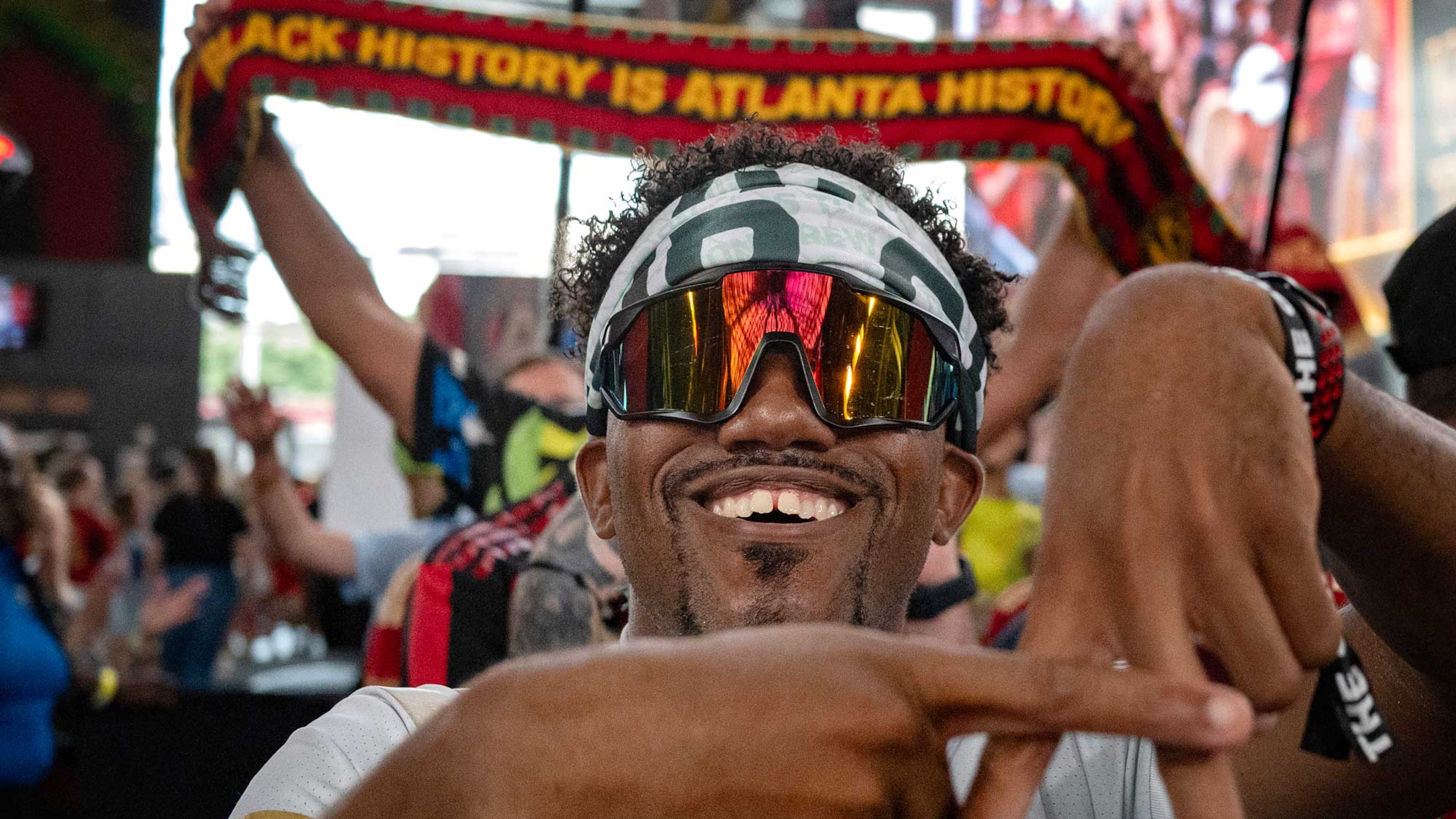
Her eyes fixate on the image of an Atlanta United supporter marching before a match against Toronto FC in August 2025. He’s got a huge grin, wearing snow goggles and a white headband, using both hands to form an “A.” Behind him, a scarf bears the text: “Black history is Atlanta history.”
“I think this body of work, even though it’s fandom, it’s about us,” says the Atlanta-based artist known for her series “#1960Now,” “Suburbia,” “Plastic Bodies,” “Young Americans” and “Invisible Empire.”
The 59-year-old’s work has explored conceptual and documentary spaces. She’s documented Black life across hip-hop culture, farming and social demonstrations via candid and portrait photography. She’s followed Black Lives Matter protests, has work in the National Museum of African American History and High Museum of Art.
“Footwork: Where We Gather” is a combination of new works in visual conversation with classic images from veteran sports photographer Walter Iooss on display in the John Howett Works on Paper Gallery at the Michael C. Carlos Museum of Emory University. On display through July 19, “Where We Gather” looks at the sense of belonging and community that comes with pro sports.
It’s part of a larger initiative, Footwork, inspired by the 2026 FIFA World Cup coming to Atlanta in June. “Where We Gather” is one of three interconnected exhibitions across Emory campuses, celebrating the city’s soccer history, sports culture and current status as a world football hub.
The idea came to Bright, a Leica ambassador, after talking to Emory’s senior director of culture, community and partner engagement, Clint Fluker, about doing a project that found its muse in sports. Though she was less concerned with shooting on-field action, it was the very human response to what happens in and around arenas and stadiums that Bright wanted to show.
Her hope is showing how our houses of athletic worship represent safe spaces in a time of political unrest, war and uncertainty.
“I think we’re yearning for connection from a global standpoint. I mean, look at the world and how it’s shifting and all of the noise out there,” she said.
Over the course of three to four months, Bright set out to observe how metro Atlanta’s sports communities came together. She worked closely with Works on Paper curator Andi McKenzie. It was a process that involved narrowing hundreds of photos down to a couple dozen.
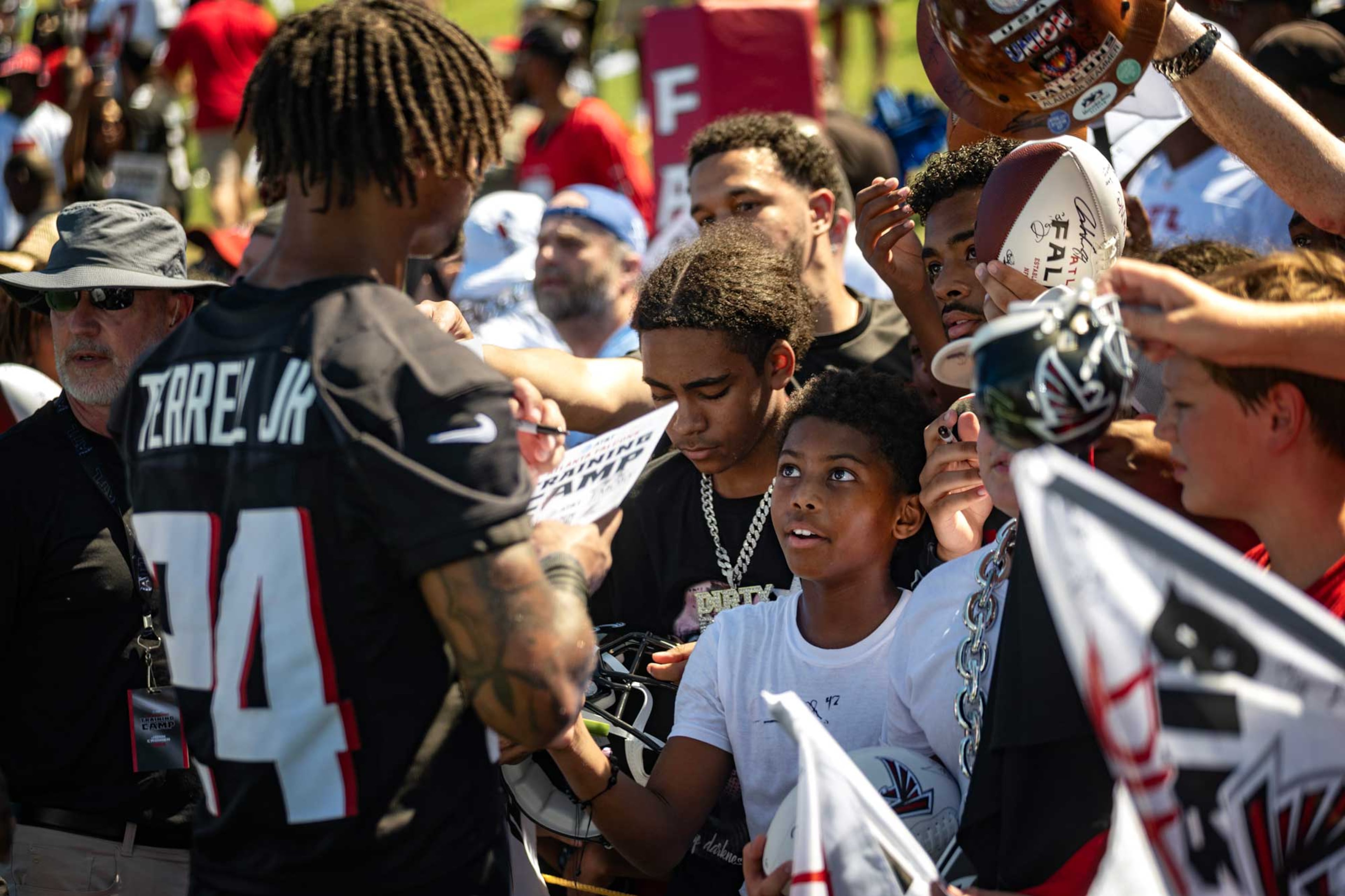
Stops included Falcons practice at Flowery Branch and the team’s game in Berlin last November. She stopped at Atlanta United matches, tailgates and the World Cup draw party in Buckhead. On the sidelines, while traditional sports photographers questioned her shot choices, Bright kept her eyes set on the everyday folks filling seats.
“She’s also photographing the things that sports photographers are not doing. So these are images we have never seen,” McKenzie said.
Admittedly, McKenzie was on the fence about how to incorporate the Iooss images. Iooss is known for capturing iconic images for Sports Illustrated over the past several decades. “Where We Gather” features Iooss’ famous “The Catch,” which shows Dwight Clark’s game-winning touchdown reception from Joe Montana in the 1982 NFC title game.
The other photo is Iooss’ 1966 shot of Bill Russell meeting Elgin Baylor midair. The idea in the curation process, McKenzie said, was to capture the story of those on the field from Iooss in dialogue with fans shown candidly and in portraits from Bright.
“The work is very different, but there’s something very interesting about the way Walter speaks about his work and the way Sheila speaks about her work. They both talk about the decisive moment,” she said, referencing photographer Henri Cartier-Bresson’s description of when timing, composition and luck all align in one image.
Whether it’s entangled legs and feet of soccer players or kids marveling at their favorite athlete signing an autograph, Bright said the key to getting those images was patience. Oftentimes, she’ll fixate on a space, place or person for 30 to 40 minutes before she takes the picture.
What stood out to her in this process? Fandom — yes. But more than anything, the communal aspect. If only for 90 minutes, or four quarters, that time is valuable. “We let all that stuff go at that moment, and we’re actually talking to each other,” she said.
A military brat, whose parents are from Waycross, Georgia, Bright came to Atlanta in 2000. She’s made it a point to document the South and its people. When she traveled to Berlin for the Falcons game, it was her first time being back since growing up in the country. Bright is curious about how supporters of teams coming in town for the World Cup will interact with Atlanta’s culture. She jokes that it’s more than “Real Housewives” memes, and no one calls it “Hotlanta.”
When those same folks show up inside the Carlos Museum to see “Where We Gather,” there’s a message within those framed photos she hopes visitors take with them. “I’m going to try to give a different perspective of how people perceive Atlanta. That’s what I wanted to do,” she said.
And for locals?
“They’re on a global stage right now, and they’ll be able to see themselves.”
IF YOU GO
“Footwork: Where We Gather”
Through July 19 at Michael C. Carlos Museum. 10 a.m.-5 p.m. Tuesday-Saturday, noon-5 p.m. Sunday. Adults, $10; seniors and ages 6-17, $8. 571 S. Kilgo Circle NE, Atlanta. carlos.emory.edu.
About the Author

Gavin Godfrey is an editor and Team Lead for UATL, the AJC's Black culture franchise. He's an award-winning writer and editor from Atlanta who's covered everything from OutKast to the water boys. Before joining the AJC, Gavin worked for Capital B Atlanta, CNN, and Creative Loafing.