
Tunde Akinyeke wants to get more Black people to the start line
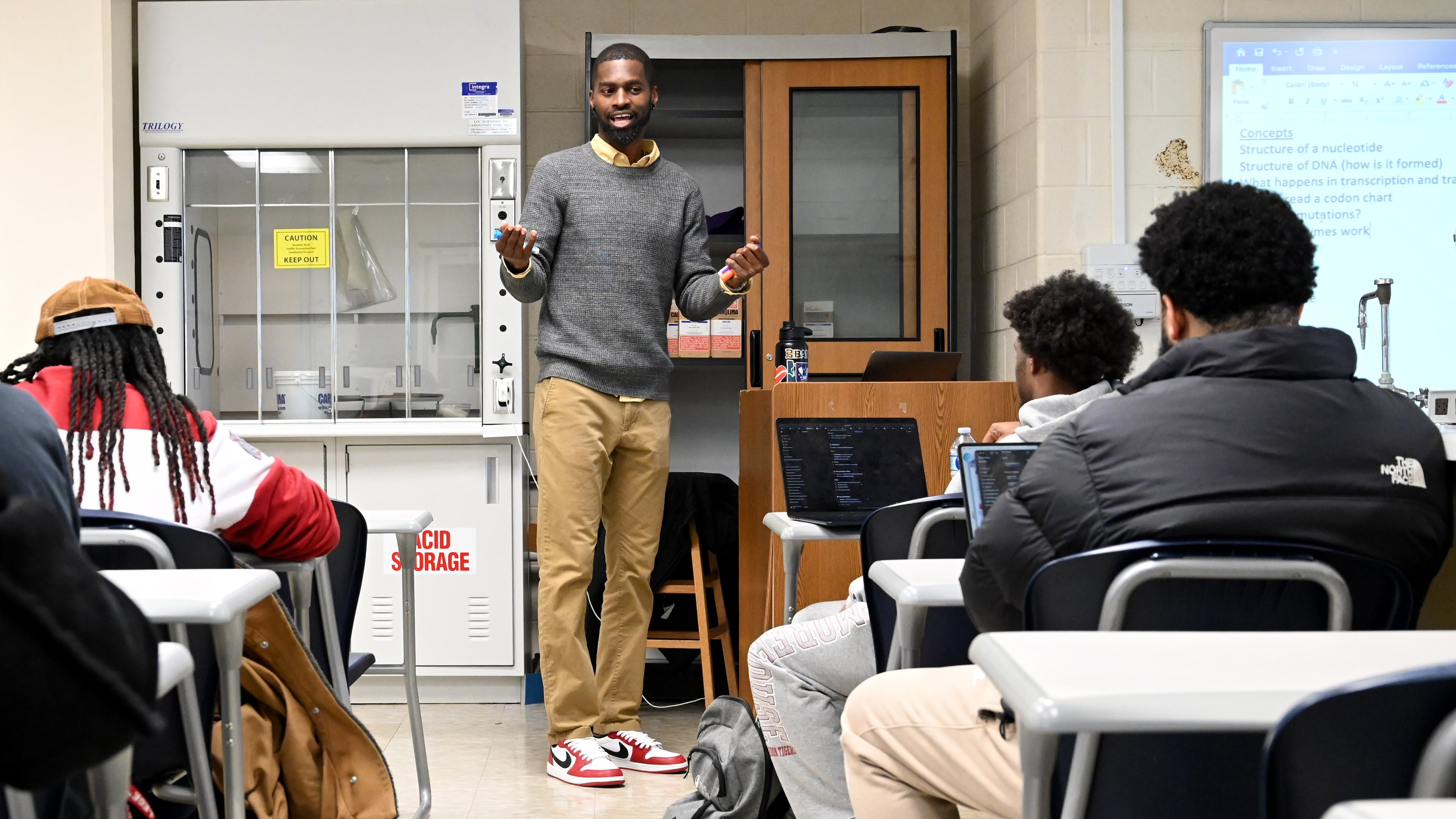
Each time you see Tunde Akinyeke it’s highly likely he will have a different pair of kicks on.
One, because he has an entire closet dedicated to his sneaker collection. Two, he’s an avid runner who rotates through dozens of pairs of trainers for his easy jogs, speed workouts and long runs.
But, these aren’t the only kind of shoes he’s filling.
During the day Akinyeke, who holds a doctorate, teaches and does prostate cancer research as an adjunct biology professor at Morehouse School of Medicine and a faculty lecturer at Clark Atlanta University.
After classes, he serves as co-captain of Atlanta Run Club on top of leading his own Chasing Roses Training cohort, where he is a running coach.
“I think the parallel between running and biology is that each requires a good amount of work to be successful in it,” Akinyeke, 44, said about the parallels between the two and why he’s drawn to both.
“You have to embrace how boring it can be at times. You have to build consistency and learn to rely on discipline, not just motivation.”
As a run coach in a densely Black-populated city and a professor on historically Black college and university campuses, Akinyeke is in an unique position. He’s simultaneously creating more potential inroads for Black people in STEM as well as adding to the population of Black runners — which is key considering that accessibility and visibility have been issues for Black people in both fields.

In 2021 the U.S. Department of Labor reported that job growth in STEM is set to double the rate of all job growth by 2031.
In contrast, another study that same year from scientific research institute RTI International said Black Americans earned just 5% of all STEM-related doctorate degrees. A Pew Research Center analysis from the same year concluded that Black people accounted for only 9% of the STEM workforce.
These statistics paint a picture of Black people being left behind.
Similar trends can be seen in the running space and across health data for Black Americans.
Research from a 2021 study by Running Industry Diversity Coalition says Black people made up 11% of people who identified as runners. As Black Americans continue to lead the U.S. in deaths resulting from diabetes, Akinyeke is hoping he can teach and coach more Black people to follow his size 14 footsteps in the classroom and on the road.
“When it comes to living a longer life, whether for myself or for people who look like me, the first things are knowledge and understanding,” says Akinyeke, who discusses trends like these at length in the Men’s Health class he also teaches at Morehouse College. “One of my goals is to spread these messages through the means that I know how.”
Chukwuma Nduka, a 2025 Clark Atlanta University graduate, started getting the message during his junior year when Akinyeke was assigned to be his mentor via the Louis Stokes Alliances for Minority Participation program. The plan was for Nduka to be trained in cancer research, but Akinyeke went the extra mile and began inviting his mentee to the runs he leads with Atlanta Run Club.
“My initial thoughts were, if I go, maybe I could use this as a new way to work out and stay close with my mentor at the same time, and for the next two years that’s exactly what happened,” said Nduka, who soon became a weekly regular at the runs. Akinyeke’s mentorship also opened the door to Nduka hosting his own Nike-sponsored running events at Clark Atlanta, Morehouse and Spelman College.
Being able to immerse himself around Black people on and off campus with help from Akinyeke was more than welcome. Nduka spent much of his childhood being “tolerated” growing up in Des Plaines, Illinois and La Crosse, Wisconsin. Now a graduate student at Charles R. Drew University College of Science and Health in California, Nduka credits his mentor for making his time in Atlanta meaningful.
“I had the best four years of my life in college,” said Nduka, noting that Akinyeke also wrote his recommendation letter for graduate school. “(Akinyeke) stands out over all of my other professors not only because of his charisma, but because of his effort to build relationships with his students.”
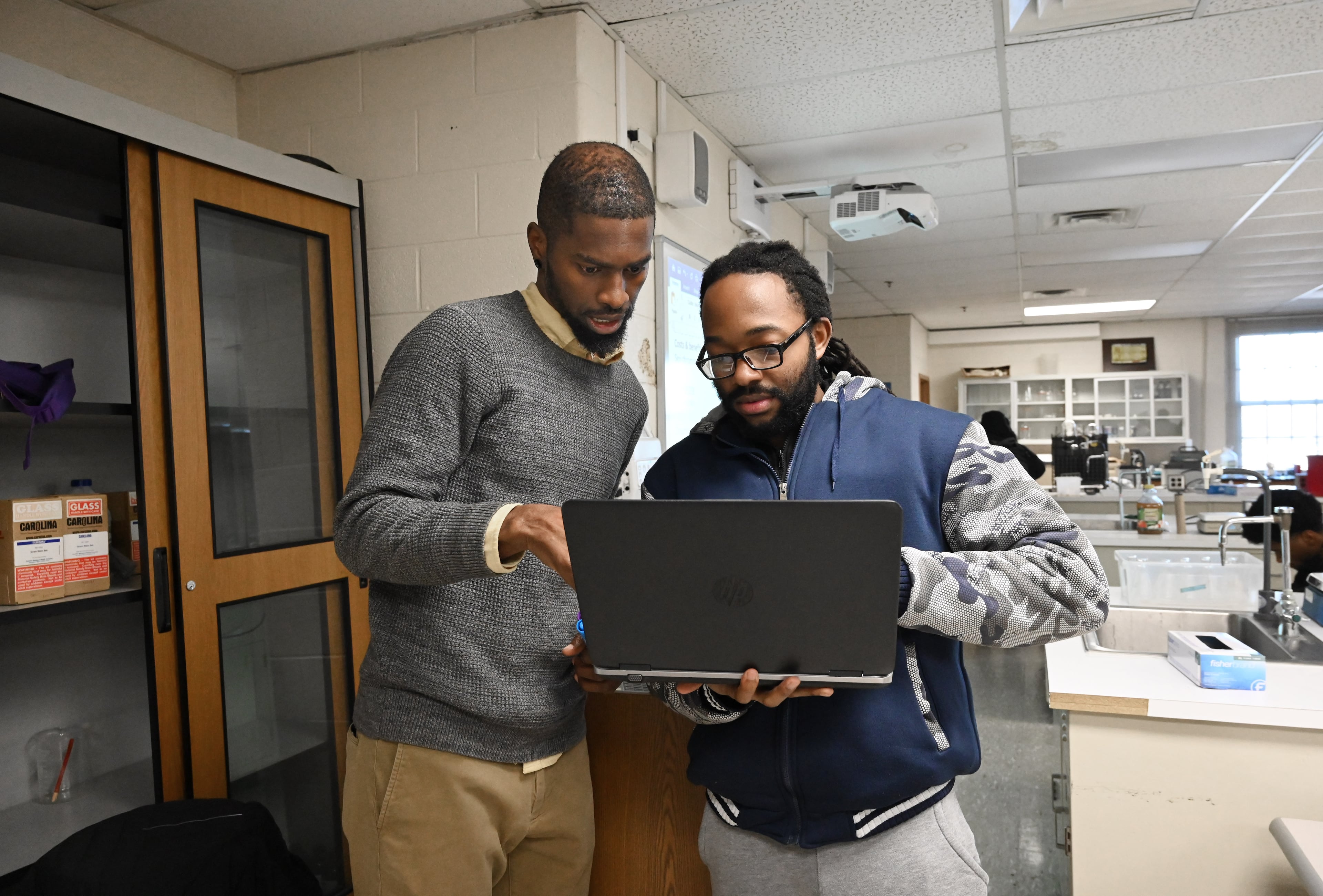
An opportunity to mentor a younger version of himself and see him pay it forward may not have happened in Akinyeke’s previous stops.
Born in Washington, D.C., and raised in nearby predominantly Black Prince George’s County in Maryland, Akinyeke bounced around the country before landing in Atlanta in 2021.
The journey started at HBCUs, first graduating from University of Maryland Eastern Shore with a biology degree, then earning his doctorate in biomedical sciences at Meharry Medical College in Nashville, Tennessee. From there he attended New York University for a fellowship and briefly returned home to D.C. to work as a medical analyst for the Food and Drug Administration. When funding ran out for that program, he moved across the country to Portland, Oregon, for another fellowship opportunity in 2014.
It was here that Akinyeke — who stands at 6 feet, 5 inches tall — was forcibly introduced to running at the suggestion of his doctor, who advised Akinyeke to abandon his first love, basketball, after breaking his hand dunking in a pro-am league.
“I would go out and see all these groups of white people just running together,” said Akinyeke, who jumped right into the sport, training for and entering the Miami half-marathon after some convincing from friends. He admits to not knowing what he was doing at first, running in basketball shorts and old sneakers.
“I’m like, man, they’re having so much fun,” Akinyeke said. “I wonder if there’s, like, a group of Black people who are running like this?”
There wasn’t.
That’s when he decided to start his Chasing Roses Run Club in Portland. In what he describes as a “slow build” in a city where the Black population was barely 6% at the time, any given run could have either three or 30 runners, many of which were his friends and fraternity brothers.
He took the idea with him to Seattle the following year when he landed a job as a college instructor. While he never planned to make the Northwest his permanent home, one event expedited his exit: being called the racial slur by a motorist who almost hit him as he was crossing an intersection on a run.
While the incident didn’t lead to physical violence, the emotional toll was damage enough.

“After I finished my run, I just saw white people outside throwing Frisbees,” Akinyeke said. “It just made me mad because I’m, like, y’all had no idea what just happened to me and have no idea what it’s like to be Black in this country. That was the tipping point for me. Like, I gotta get out of here.”
Still fond of the times he spent visiting Atlanta when he was studying in Nashville, Akinyeke began looking for work in the “Black mecca.” After applying around, he secured a position as a professor at Morehouse School of Medicine.
When he settled in, finding Black running groups wasn’t a problem. But, as a long-distance runner, he did have a hard time finding runners who were near his athletic level. Hoping to pull others up with him, he obtained a coaching certification and retooled his Chasing Roses concept from a run club into a training group.
While the group is open to all, it operates with Black runners in mind. To date he has coached runners who have ran in numerous local races, including the Peachtree Road Race and Publix Atlanta Marathon, all three of the major North American marathons (Boston, Chicago and New York City), as well as the Berlin Marathon.
His clients have also ran in half- and full marathon races in Arizona, California, Florida and Texas. Akinyeke himself has finished multiple marathons and is one of the fewer than 300 Black men to finish the race in less than three hours, according to the Ted Corbitt Institute for Running History Research.
“I get people who are seasoned marathon runners looking to get better and people who start off not able to run a mile,” said Akinyeke, who has trained more than 100 runners. “People tend to pay attention to the 1% of fast runners I’ve trained, but I want to expose running to as many Black people as possible, of all levels.”
In the case of Tori Hood, Akinyeke found himself coaching a former collegiate athlete looking to stay active after having surgery for a torn meniscus.
“When I started running, I really didn’t have any ambitious goals other than getting better, I guess,” said Hood, who played soccer at Columbus State University before relocating to Atlanta to work as a pediatric nurse. “But I didn’t know what ‘better’ meant for me.”
Hood had experiences running in 5K races and a failed attempt to finish a half-marathon without walking. Training for a full marathon didn’t enter Hood’s mind until hearing other Atlanta Run Club runners talk about traveling and training for the Chicago Marathon in 2023.
Akinyeke offered to coach Hood for the race, tailoring a plan to her physical capabilities. Hood said Akinyeke was a supportive bright spot throughout the process, but some shade the night before the race gave her extra motivation.
“There was a group of us at dinner and someone from our run club asked Tunde which women were going to BQ (Boston Marathon qualify) and he named everyone except for me,” she said. “The race was a year after my surgery, so we didn’t know what I was capable of. The goal was just to finish.”
Hood wound up qualifying for Boston with a time of 3:26:49. She followed that with a 3:14:19 performance at the Berlin Marathon in 2024. She ran the Chicago Marathon a second time in 2025 and finished with another personal record of 3:08:21, placing her among the fewer than 100 Black women who have finished a marathon in less than three hours and 30 minutes.
“The first two years, I didn’t charge anyone a dime,” Akinyeke said about his coaching services, which includes bespoke training plans and video consultation. “But when the BQs and PRs (personal records) started rolling in, I figured I could start.”
Akinyeke’s current Chasing Roses list includes runners in the 2026 Boston Marathon in April and Grandma’s Marathon in June in Duluth, Minnesota, a town that has an 85% white population. When Akinyeke ran the latter in 2024, he saw only four other Black people the entire weekend and two of them came with him.
This year he is running the course with nine Black runners he trains with.
“A lot of times, when Black people show up to races, we’re not expected to be there, let alone perform to a certain standard,” he said. “It’s an extra boost of confidence to show up to the start line, take up space and work through this together.”