
Artist Corey Barksdale creates Black history mural in west Midtown

After the Civil War, a family of formerly enslaved Black settlers purchased land to create their own community.
Calling it Blandtown, the area developed in 1872 during Reconstruction was inhabited by skilled Black people who became entrepreneurs, ministers, mechanics and railroad workers. They spent their free time stock car racing and enjoying live music.
In 1956, the city rezoned Blandtown, pushed Black residents out and turned their former homes into an industrial area of Atlanta.
Now, Atlanta-based artist Corey Barksdale wants to remind residents and tourists of Blandtown’s lost history with a “public art gallery” in the neighborhood.
“The land wasn’t cultivated at the time, so they had to really work hard to make it livable. I’m trying to tell the story about how powerful the individuals who came before us really were,” Barksdale, 53, told UATL.
Barksdale is the designer of “Past, Present, Future,” a large-scale mural depicting Blandtown’s evolution into west Midtown at the intersection of 17th Street and Northside Drive. The 30-foot-tall, 170-foot-long artwork is a timeline with colorful images of the Bland family, blue-collar workers and how their community became Atlanta.

Spending three months on the project, Barksdale stood on a boom lift and a ladder to make the expressive piece with bright shapes, melanated characters, dark brushstrokes and accents. He used 20 gallons of exterior paint, 60 cans of spray paint and several paintbrushes to transform the blank wall into a work of art.
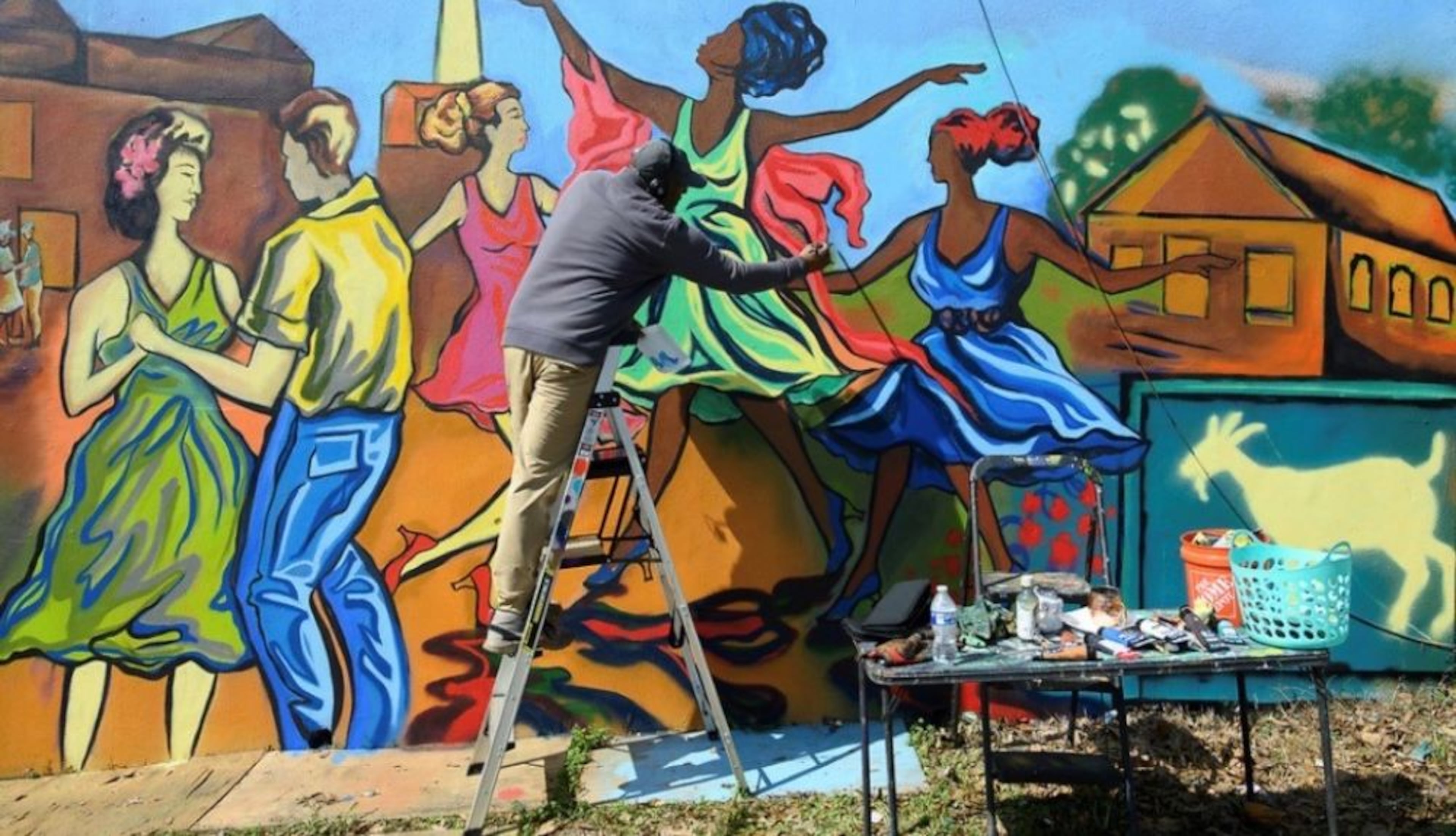
“It’s a prime location where people can have pride in the city, appreciate and feel good about themselves. When they walk down the street, I want them to feel the resilience and dignity I put into the art,” Barksdale said.
“Color is cultural, energy and has a lot of movement. It pulls you in so the story can be told. If you don’t have the elements that are going to make the mural powerful, then you don’t have anything.”

In August, Barksdale was awarded the commission by the City of Atlanta’s Bridges, Tunnels and Walls initiative to create public art in time for FIFA World Cup’s first Atlanta game on June 15. He beat hundreds of submissions to land the project.
Barksdale spent a month researching Blandtown online, visiting photo archives at public libraries and writing the proposal.
“It was an eye opener discovering there was a rich African American history in this area that was not known. Blandtown was a nice community where hard-working individuals and community were respected,” he said.
“Individuals forget where they came from and what led up to us being here, so we have to respect those people who made it possible for us to be here right now.”
Barksdale used Adobe Photoshop to turn stock images from the libraries into a collage before he sketched the mural on his iPad.
“I improvise, create from the heart based on what I felt would actually have an impact on the city, revise (it) over and over until I got something that really stuck,” he said.
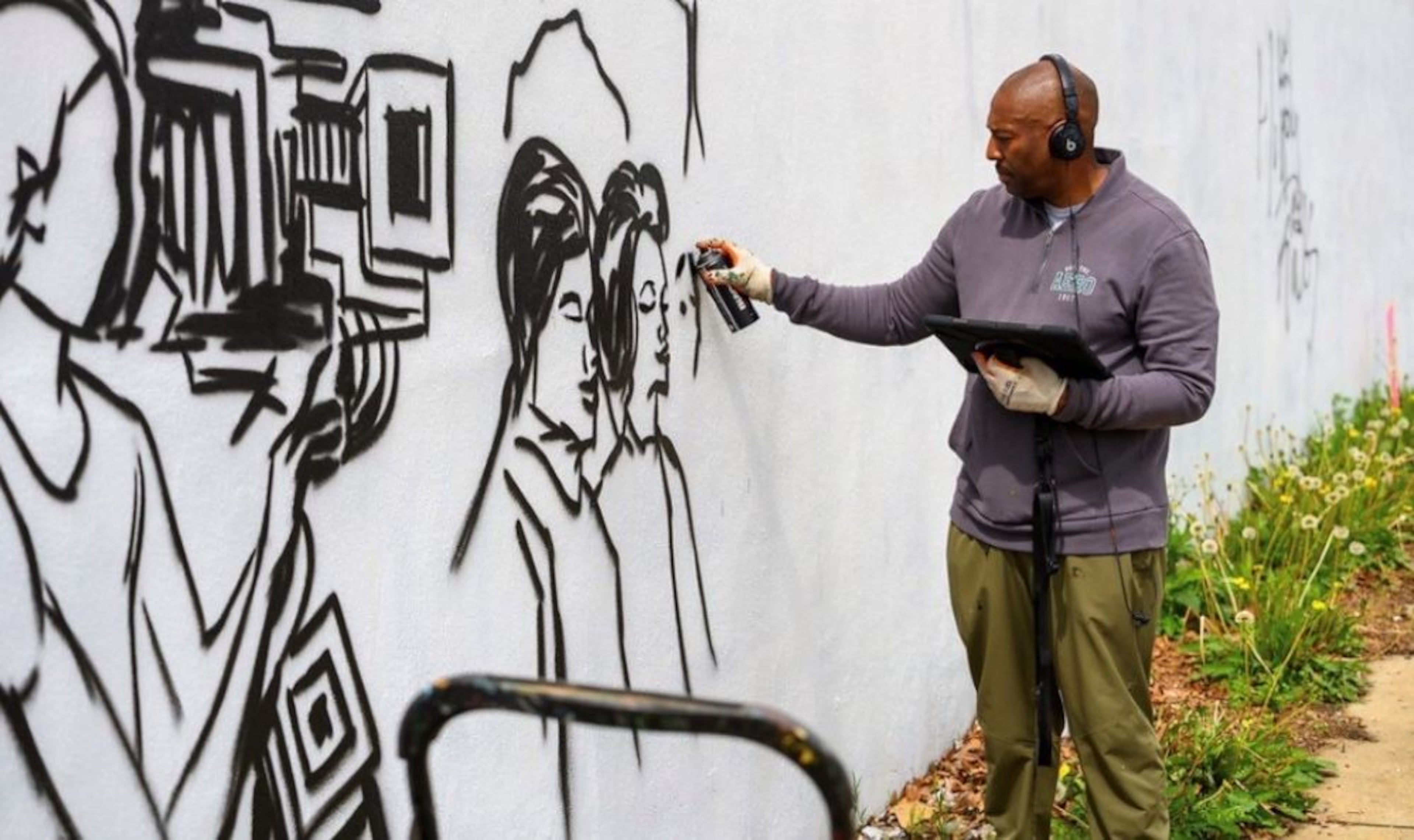
In 1994, Barksdale relocated to Atlanta from Nashville to attend Atlanta College of Art, which later became Savannah College of Art and Design.
He said he felt stifled by his hometown’s lack of ethnic diversity. “It was very segregated. The point of view from a lot of people was conservative and outdated,” he said
Barksdale’s move to Atlanta helped him gain confidence in his creativity. “I really started to understand uniqueness as a positive here. I fell in love with the city, because people were relaxed in their own skin. I knew this was exactly where I wanted to be,” he said.
In 2011, Barksdale created “I Am a Man,” his first public art commission in Atlanta themed around civil and human rights.
The mural was created as part of ELEVATE Atlanta Art Festival, a program designed to transform Atlanta neighborhoods with large-scale work.
Seven years later, he spent 18 months in South Africa and saw visual artists using similar techniques. “I noticed a lot of what I do here is the same thing they do there, and I felt connected to my heritage,” he said.
Barksdale’s art arrives at a time when the current presidential administration demands museums remove exhibits recognizing diversity. He said the mural pays tribute to the Black community’s contributions to developing Atlanta.
“There’s a lot of confusion about who we are and what we’ve done in our society, and we need to reiterate all of the accomplishments that many people have done before us,” he said.
Barksdale plans to tell additional stories about Atlanta’s unsung heroes through public art.
“I represent those people who built this city, made it what it is but don’t always get the praise,” he said.
He hopes to design murals about untold Black history in other major cities.
“There are communities there that need to be represented, so I’d like to go to those places and tell their stories.”