
Black History Month

Rooted in resilience: Black Georgia farmers talk land and legacy
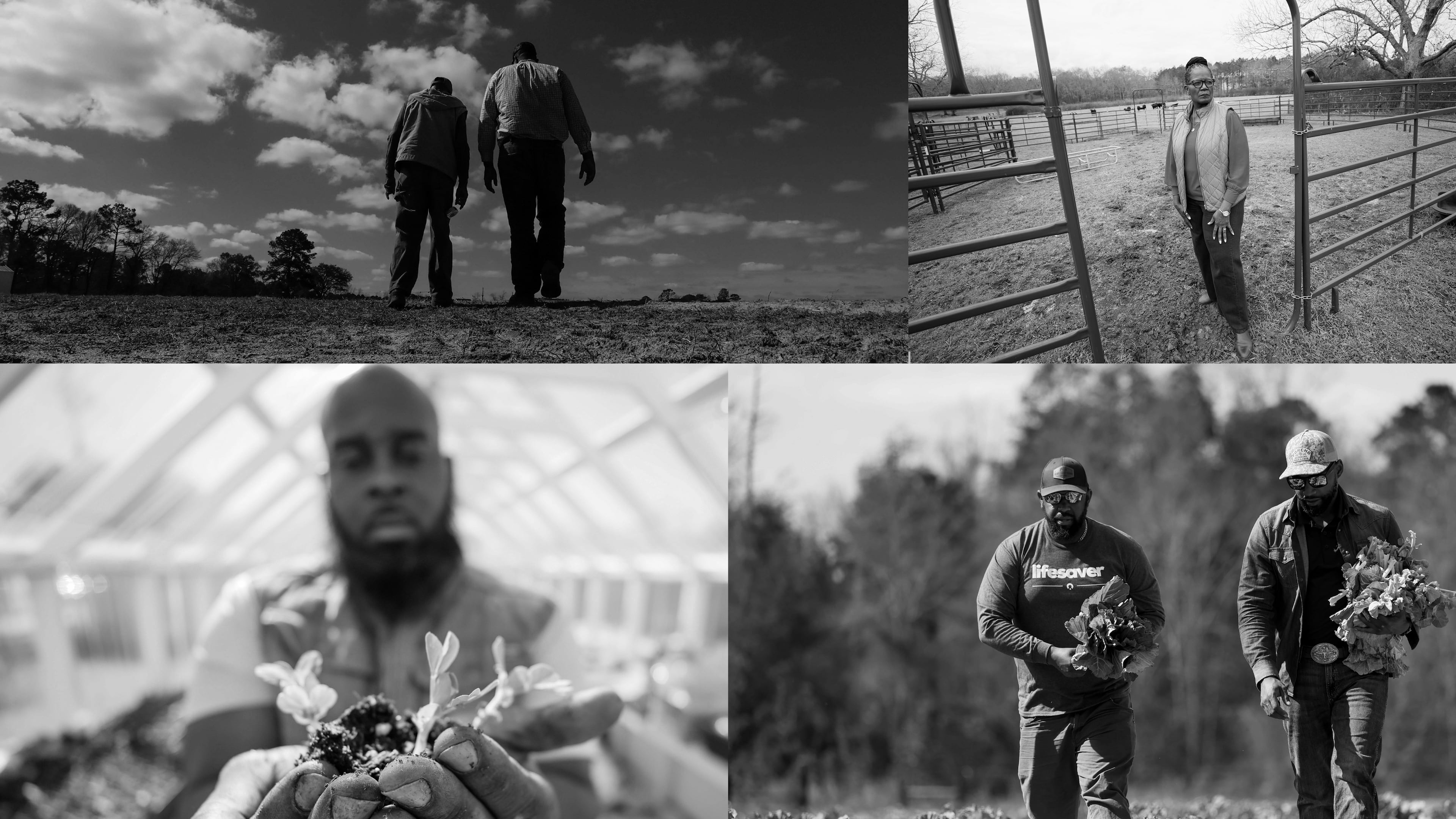
From produce to cattle, farm owners share how generations past and present inspire them.
From Sparta to Smithville, and from Collins to Albany, some Black farmers in Georgia’s Black History Month are proudly representing the land passed down from their ancestors with respect and dignity. They are keeping the legacy alive for future generations and take great pride in providing for their families and communities. (Miguel Martinez/AJC)

In his 1963 speech, “Message to the Grass Roots,” Malcolm X delivered his thoughts on how to spark true change for Black people.

“Revolution is based on land. Land is the basis of all independence,” he said. “Land is the basis of freedom, justice and equality.”

Then and now, ownership has been looked at as a form of Black liberation.

Some have seen their families live off row crops and livestock for generations. Others are building legacies for the future.

They’re also scarce.

Black farmers represent 4% of producers in Georgia, and like their counterparts, they’re facing federal funding shortages and skyrocketing costs from tariffs.

That low percentage is part of a nationwide decline over time. Over the past century, Black farmers have lost more than 12 million acres of farmland. According to agricultural experts and the government’s own admission in court, it’s partially the result of systemic racism in lending and exclusion from agricultural programs.

During Black History Month, some of those same farmers spoke to The Atlanta Journal-Constitution about how the successes and challenges that their ancestors faced guide them today. Like their parents and grandparents, they’re finding ways to support and educate land owners who look like them.

That sense of unity and collaboration gets amplified during Black History Month.

Musa Hasan, Bread and Butter Farms, Sparta, GA

Musa Hasan, co-owner of Bread and Butter Urban Farm in Sparta, GA, stands inside a nearly completed greenhouse for planting various vegetables on Thursday, Feb. 12, 2026. “Our main goal is to develop a space where we can sustain ourselves off the land without stress. During Black History Month, we especially emphasize the importance of teamwork in building our community,” Hasan said. (Miguel Martinez/AJC)

Musa Hasan, 46, keeps his multigenerational family roots alive providing organic and sustainable farming at Bread and Butter Farms over 100 miles east of Atlanta in the Sparta area.

At the five-acre Bread and Butter Farms, Hasan utilizes what the Earth provides holistically to grow vegetables, fruits and herbs with zero chemicals. They manage the soil, plant heirloom seeds and harvest to deliver the most nutrient-dense produce possible.

Hasan cradles a bunch of spinach grown using organic, zero-chemical and biodynamic methods. “I feel really good when the community responds after they eat our products. They notice right away when they eat produce without chemicals,” he said. (Miguel Martinez/AJC)

Hasan and his wife, Micole Hasan, 44, founded Bread and Butter in 2012 as a small urban farm to supply local farmers’ markets.

“One of our goals is to reach people who want to eat better and understand land stewardship,” Musa Hasan said.

The Hasans met in college at Tuskegee University, where Musa tutored Micole in organic chemistry.

“I mean, for the most part, our focus is really to create a space where we can live off the land without pressure,” Musa Hasan said.

The Hasans purchased the land together.

Hasan checks on a curly kale plant in one of the greenhouses. (Miguel Martinez/AJC)

“Our aim is to bring dignity and honor to the Black experience when it comes to farming,” Musa Hasan said.

That mission is magnified this time of year.

“In this society, we strongly value the idea of building as a team; that’s what Black History Month represents,” he said.

Willie Scott, Willie Scott Farms, Collins, GA

Willie Scott, 55, a third-generation farmer who grows cotton, peanuts and corn, walks with his 82-year-old father, Harry Scott, who still enjoys being involved in the farm’s activities in Collins on Tuesday, Feb. 17, 2026. The farm has been in their family since Willie Scott’s grandfather purchased it in the 1940s. “As a Black farmer, you have to make a point to do everything correctly because it’s difficult regardless of your race, and you also want to avoid mistakes, both personally and professionally, since it’s already challenging and people are watching you,” Scott said. (Miguel Martinez/AJC)

Willie Scott, 55, is a third-generation cotton, corn and peanut farmer in Collins, part of Tattnall County, over 200 miles southeast of Atlanta. Three years ago, the 800-acre Willie Scott Farm took part in a partnership with Target, supplying sustainable cotton for T-shirts featured in the retailer’s Black History Month capsule.

Scott’s grandfather purchased the land in the 1940s. He and his father said they’re readying peanut crops for April, followed by cotton in May.

Willie Scott, 55, holds up a cottonseed from his farm. "As a Black farmer, I look back to the 1940s when my grandfather bought this land to understand the challenges he faced and what he achieved. The same reflection applies to my father. I use this not as a crutch, but as a stepping stone to motivate myself to pursue, surpass and recover from obstacles," Scott explained. (Miguel Martinez/AJC)

There aren’t many Black farmers around, but they do make efforts to connect and work together.

“As a Black farmer, you have to make a point to do everything correctly because it’s difficult regardless of your race, and you also want to avoid mistakes both personally and professionally, since it’s already challenging and people are watching you,” Scott said.

Willie Scott drives his tractor as he prepares the soil for the next crop, corn, after harvesting cotton from the previous season. (Miguel Martinez/AJC)

Willie Scott’s 82-year-old father, Harry Scott, is still very much involved in the day-to-day operations.

Growing up, Scott saw what his grandfather and father went through as minority farmers trying to build wealth through their land.

“I look back to the 1940s when my grandfather bought this land to understand the challenges he faced and what he achieved. The same reflection applies to my father,” he explained.

“I use this not as a crutch, but as a steppingstone to motivate myself to pursue, surpass and recover from obstacles.”

Tony Berry and Cedric Berry, Berry Family Farms, Ludowici, GA

From left, cousins Cedric and Tony Berry, third-generation farmers and cattle ranchers, collect the remnants of last winter’s collard greens at Berry Family Farm in Glennville, on Tuesday, Feb 17, 2026. They officially started managing the farm six years ago, but have been attached to it their entire lives. (Miguel Martinez/AJC)

In Ludowici, Georgia, cousins Tony, 39, and Cedric Berry, 41, are carrying on a legacy from their family. The pair are third-generation farmers and cattle ranchers who’ve started managing 400-acre Berry Farms six years ago.

Their parents and grandparents also farmed in the small town located between Hinesville and Jesup. In the winter months, the cousins are collecting the last bits of collard green stock.

Cedric Berry gives a tasty treat to one of his cows. “The production challenges on the farm include economic constraints, resource scarcity and limited access to information. Farmers, especially Black workers, face these issues, though less severely than in the past. They often struggle with late or missing information and must conduct extensive research to find opportunities. Even when they succeed, hurdles are part of the process,” he said. (Miguel Martinez/AJC)

Tony and Cedric Berry are quick to point out that their land has been in the family long before them. Their parents, now in their 60s, were young adults here.

“Every step I take, I think about who was here before me and what they did. It’s a good feeling to know this land has been passed down and that I need to take care of it and pay it forward,” Tony Berry said.

From left, Tony and Cedric check on a group of sheep, cattle and donkeys at their family farm. They are part of the South Georgia Black Cattlemen's Association, with about 30 members. Tony is president, and Cedric is vice president. They are trying to do all they can to help bring education and opportunities to cattlemen across Southeast Georgia and other regions. (Miguel Martinez/AJC)

The Berrys are also working to provide more resources and education for Black cattle farmers. They’re members of the South Georgia Black Cattlemen’s Association. Tony serves as president; Cedric, vice president.

“The production challenges on the farm include economic constraints, resource scarcity, and limited access to information. Farmers, especially Black workers, face these issues,” Cedric Berry said. “They often struggle with late or missing information and must conduct extensive research to find opportunities. Even when they succeed, hurdles are part of the process.”

Cedric Berry hopes their work on and off the land bears fruit for the next crop of farmers to come.

“It’s about honoring our ancestors’ care for this land and carrying that torch forward,” he said. “It’s an honor to pass it on and improve it for future generations.”

Alfred Greenlee, Green Oak Farm, Albany, GA

Alfred Greenlee, a farmer in southwest Georgia, stands near bales of Bermuda hay at Green Oak Farm in Albany on Wednesday, Feb. 18, 2026. Greenlee reconnected with farming after retiring as a stationary engineer at a local company, taking pride in raising Black and Red Angus cows and Bermuda hay. (Miguel Martinez/AJC)

Alfred Greenlee, 72, will tell you that he enjoys “playing in the dirt.” Greenlee operates Green Oak Farm in the Albany area. The 52-acre farm started off specializing in pasture boarding horses and growing hay.

Greenlee says he grew up around farming. One of his grandfathers had a 200-acre farm where they farmed peanuts, cotton and corn. At Green Oak, Greenlee has black and red Angus cows and produce.

“Not only do Black farmers face challenges; I think it is difficult to be any farmer today because fertilizer, lime and equipment prices have gone sky-high, and tariffs have a lot to do with it,” he said.

Greenlee checks the aroma of Bermuda hay to ensure it is in the proper condition.  (Miguel Martinez/AJC)
Greenlee checks the aroma of Bermuda hay to ensure it is in the proper condition. (Miguel Martinez/AJC)

Like other local farmers of color, Greenlee takes advantage of resources from the University of Georgia College of Agriculture department and Fort Valley State University’s School of Agriculture.

He’s a member of the Southern Farmers Collaborative Group, which aims to improve farmers’ quality of life and provide education resources for building agribusiness.

“One of the things that we teach from a collaborative perspective is record keeping, making sure you have a business license for gardening, and you can take advantage of it,” he said.

Alfred Greenlee and his wife Debra collect collard greens at the greenhouse they were able to build in collaboration with the USDA. (Miguel Martinez/AJC)

It’s not lost on Greenlee that despite the challenges for his one-man operation — and Black farmers nationwide — he’s got a blueprint from the past.

“Black History Month means looking at all the people who have come before us and the journeys they took to open doors we can walk through today. It also means recognizing that my grandfather tried to get loans and other financial support but wasn’t able to,” he said.

“In today’s world, it’s a lot easier.”

Carolyn Edwards Ford, Roe Edwards Farm, Smithville, GA

Carolyn Edwards Ford, a cattle and raw produce farmer from Smithville, GA, at her family's Roe Edwards Farm on Wednesday, Feb. 18, 2026. “I’m a woman, and many men say, ‘You’re the strongest I’ve seen.’ As women, we carry ourselves, and I get to speak with other women in business. It’s like you represent more than yourself — you’re carrying a torch for future generations watching your every move.” (Miguel Martinez/AJC)

The story of Roe Edwards Farm starts with a promise. Before he died, Carolyn Edwards Ford’s grandfather asked her father to take over the family farm he’d operated since 1939. Nearing the end of his life, Ford’s father made the same request of his daughter.

Today, Ford, 61, along with four siblings, operates Roe Edwards Farm. The land’s 350 acres includes produce and one of the country’s largest chestnut orchards. The land sits in Smithville, over 150 miles directly south of Atlanta.

The impact her farm has is something that drives Ford.

Ford exits the cattle holding pen at the farm. “As part of the Southern farmers Collaborate Group, we work with minority farmers and share the same vision of helping one another, whether it's filling out documents, providing manpower, or going out into the community to bring in a wealth of resources that could benefit each farmer,” Edwards Ford said. (Miguel Martinez/AJC)

“You have to take care of the land that you have, but you have an asset that you can bless other people in so many ways, from your livestock to your vegetables to whatever you may be producing on your farm,” she said.

In this business, Ford is an anomaly. Black women represent less than 1% of farmers in the U.S. Admittedly, the significance of being Black, female farmer didn’t really dawn on her till she started attending industry meetings and events.

Often, she’d hear the same quip: “You’re the strongest woman I’ve ever seen.”

She has to laugh, but Ford gets it.

“I don’t want to call it a burden or anything, but you carry the torch for generations to come, and also the generations who are looking and watching you and your every movement,” she said.

Ford explains the pride she and her siblings take in preserving the family legacy. The farm dates to 1939, and the Edwards family keeps the promise Ford's father made to her grandfather to care for the land. (Miguel Martinez/AJC)

To Ford, working the land, collaborating with other minority farmers, is just keeping in line with practices set forth by her ancestors.

“Minority farmers, they depended on each other. If you lack equipment, funds, crew, you work together,” she said. “We are still networking today.”


This year’s AJC Black History Month series marks the 100th anniversary of the national observance of Black history and the 11th year the AJC has examined the role African Americans played in building Atlanta and shaping American culture. New installments will appear daily throughout February on ajc.com and uatl.com, as well as at ajc.com/news/atlanta-black-history.

About the Authors
Gavin Godfrey is an editor and Team Lead for UATL, the AJC's Black culture franchise. He's an award-winning writer and editor from Atlanta who's covered everything from OutKast to the water boys. Before joining the AJC, Gavin worked for Capital B Atlanta, CNN, and Creative Loafing.