
Meet the man of Morehouse balancing a 4.0 GPA and a pro boxing future

It was about 35 degrees outside — and not much warmer inside — at the nondescript Bout Boxing Studio in Lithonia when Chad Pitts walked in.
Just over 48 hours earlier, the 132-pounder had won the Georgia Golden Gloves State Championship.
Dressed in a sweatshirt and pajama pants, Pitts was already back at work.

Two portable forced-air heaters hummed on either side of the ring. Pitts wondered aloud if this was any better than the summer, when temperatures inside the gym can climb to more than 110 degrees.
He set a bell timer on his phone, slipped in his earbuds and got to work — two rounds of jump rope, then the heavy bag. Two more on the speed bag. Then two rounds in the ring, working on his footwork.
Finally, he waved his father, Christopher Pitts, into the ring.
The punches came fast and sharp, snapping loudly against the focus mitts.

Christopher Pitts, his son’s trainer and manager, said he is already fielding offers for him to turn pro as early as May. If he waits, though, he could also make a run at the 2028 U.S. Olympic team.
Chad Pitts, known in boxing circles as “Candyman,” pulled off his gloves and smiled.
“Turning pro is the ultimate goal,” Pitts said. “I’ve been grinding toward it since I was 10 years old.”
What makes Pitts, ranked fifth nationally in his weight class by USA Boxing, unusual is not simply his talent.
It’s where he spends his days.
Pitts is a 20-year-old junior economics major at Morehouse College, one of the nation’s most prestigious schools for men.
The historically Black Atlanta institution has produced generations of leaders across civil rights, academia, politics, business and even the high hurdles.
Prizefighters rarely emerge from its classrooms, though.

“The path is different, but it’s not impossible. Morehouse showed me that from Day 1,” said Pitts, who has a projected 4.0 grade-point average headed into midterms. “One thing I love about Morehouse is that you will find us in places you never thought we would be. I don’t see boxing as an irony, I see it adding to the prestige of what Morehouse is and how we can dominate any field. ”
In February, his victory in the 132-pound Elite Male Division at the USA Boxing 2026 International Tournament in Colorado marked a breakthrough moment — not just for him, but for the fledgling Morehouse Boxing Club.
“Chad is a blueprint — you can compete to go pro and still maintain school,” said Jacobey Bell, a recent Morehouse graduate and founder of the campus’s boxing club. “Nobody’s really tried to do that before.”
For Pitts, that balance is a daily priority.
“My education is always first,” he said. “Student comes before athlete in student-athlete.”
Warming up
For Pitts, the road to Morehouse began far from the bright lights of championship boxing. In Sylacauga, Alabama.
Pitts was 8 years old, restless during spring break. He was smaller than the other kids in town, but he had a quick tongue.
His mother decided he needed to learn how to defend himself. She tried to enroll him in karate.
That didn’t last long.
“The instructor was more on the spiritual side,” Pitts said. “She was talking about bending spoons with her mind, touching my pressure points. I just got a weird feeling from that first session.”
Pitts and his mother walked out, but outside the karate studio, one storefront was still illuminated in the darkness.
It was a boxing gym, Talladega County Boxing and Youth Activities Club, and Pitts said the light seemed to be calling him.

“I walked in and felt the aroma, the atmosphere, the sounds,” he said. “It was very small. It was a pretty bad gym, but everything resonated with me, from the old-school music to everybody being hyper-focused and sweating. Everybody looked in shape. Everybody looked confident. I was hooked.”
He went to the gym every day after school. At first he went alone. Then his father started taking him.
“If I like it, he loves it,” Pitts said.
When they moved to Atlanta in 2014, his father found him gyms, trainers and coaches to help him develop. At school, he would shadowbox. On the school bus, he would tape his knuckles.
“The kids were laughing at me, not really understanding,” Pitts said of those early days. “But I always knew there was more for my life.”

A man of Morehouse
For Pitts, who graduated from Charles R. Drew Charter School in Atlanta, attending Morehouse was never a question. His parents were both educated at Black colleges, his father at Alabama A&M and his mother, Tracy Crayton, at Alabama State.
“I was going to college. Morehouse has been the only college I’ve been thinking about since I was in eighth grade,” he said. “Everything that a Morehouse man upholds aligns with who I wanted to become.”

For his father, the decision was both cultural and practical — rooted in family tradition and in what Morehouse could offer a young Black man trying to do something rare.
“We knew Morehouse would give him a chance to pursue boxing as a student-athlete at an HBCU,” Christopher Pitts said.
Pitts arrived on campus in 2023, originally as a computer science major, but switched to economics.

On a recent Thursday afternoon, dressed in sweats, Pitts slipped into Logan Northcutt’s biology class as the professor was writing a formula on the whiteboard.
Northcutt paused, turned to the room and announced that Pitts had just won the Golden Gloves, prompting a round of applause.
Then, noticing Pitts still soaking in the moment, Northcutt called him forward. He asked Pitts to solve the equation on the board by identifying the genotypes, while another student was assigned the phenotypes.
Without hesitation, Pitts stood and walked to the front. He began writing.
Northcutt, a magna cum laude graduate of Morehouse himself, studied the board, then asked Pitts to explain his work.
When Pitts finished, Northcutt paused.
“I agree,” he said.
Pitts smiled and returned to his seat.

It is a balance Pitts moves between easily.
The ring and the classroom.
Instinct and intellect.
When he graduates, Pitts said his plan is wide open: business, corporate America or maybe following his father’s footsteps and enrolling in law school.
But that is down the road.
For many fighters, that path would begin long before college — and rarely includes one.
One notable exception was James “Bonecrusher” Smith, who graduated from Shaw University in 1975 and went on to win the WBA heavyweight title in 1986, becoming the first — and perhaps only — professional champion with a college degree.
But the path was not always embraced.
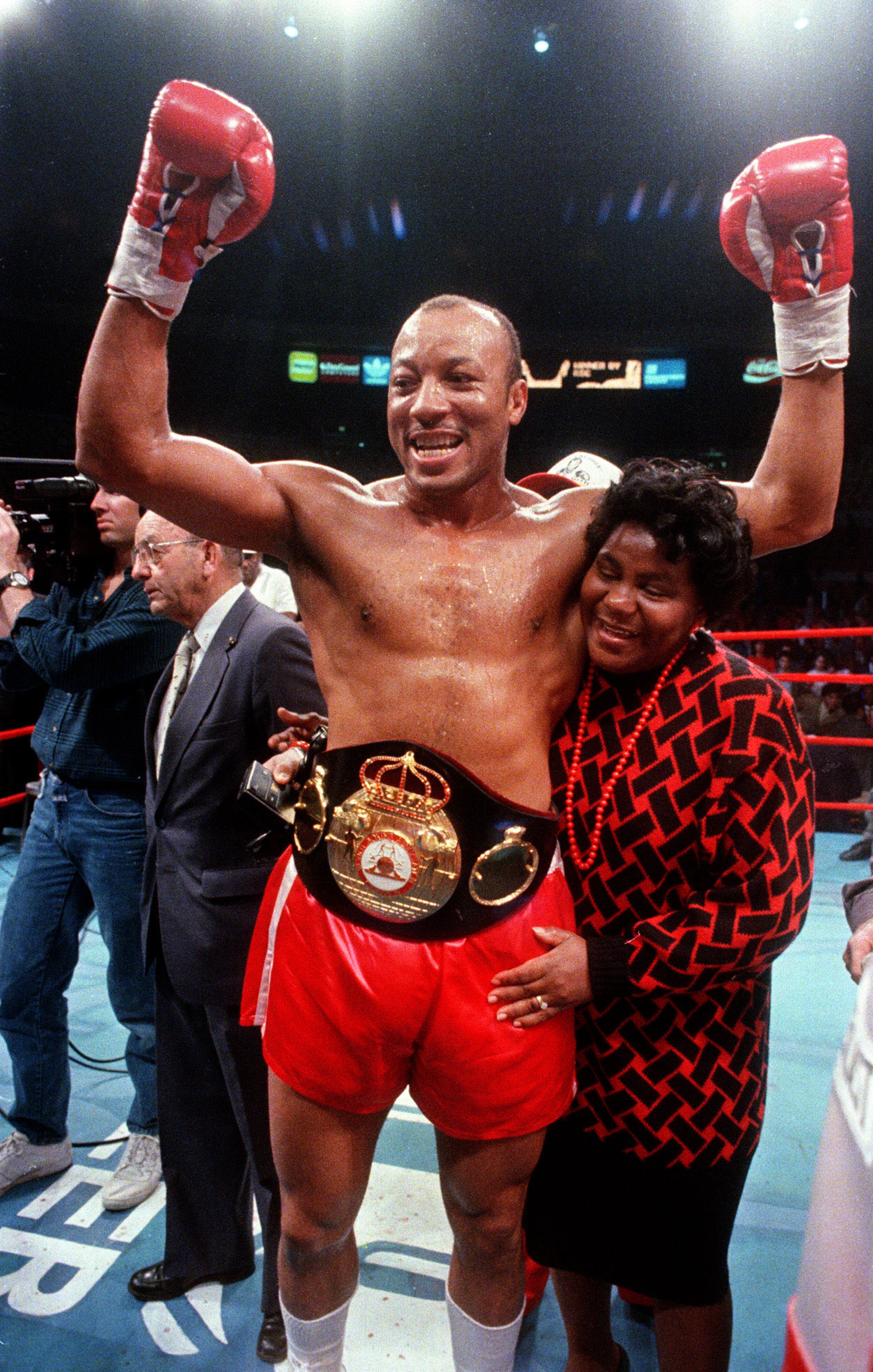
“I intimidated a lot of folks because I had a degree,” said Smith, who retired to Myrtle Beach. “The boxing community kind of made fun of it. It was strange. Even today, I don’t talk like a fighter … whatever you’re around, that’s what your mentality becomes.”
A fighting chance
Long before boxing arrived at Morehouse, the sport had a quiet but meaningful presence across Black college campuses.
Beginning in the 1930s, more than a dozen HBCUs, including Howard, Hampton and Morgan State, fielded boxing teams.
But that momentum collapsed in 1960, when the NCAA stopped sanctioning collegiate boxing after a series of deaths and safety concerns. Varsity programs quickly disappeared, and boxing survived mostly through community gyms, amateur leagues and student-run clubs.
It resurfaced at Morehouse in 2021, when sophomore Bell, searching for community in the wake of COVID, started the boxing club.
“I was just looking for a community on campus,” Bell said. “Something that helped me, mentally and physically, that I could share with my peers.”
The first version of the club was informal, chaotic and very much a college experiment.
Bell and a few others staged an impromptu fight night in a dorm. The first night drew about 10 students. The next, after word spread, packed more than 200 in the lobby. The school reprimanded Bell for the nonsanctioned event during the pandemic, then encouraged him to build the program the right way.
Since then, the club has staged eight boxing or sparring events, including a sanctioned homecoming card that drew more than 1,000 people. More than 100 fighters, including students from Clark Atlanta and Spelman, a women’s college, have participated.
In 2025, Morehouse became the first HBCU to compete in the U.S. Intercollegiate Boxing Association National Tournament, with Kaleb Hudson and Elijah McLean each winning national championships.
Until Pitts came along, it was the high point of the program.
Blood, sweat and tears
Before his Golden Gloves victory, Pitts’ road to the international championship in Pueblo, Colorado, this past February was far from glamorous.
He, his father and a teammate squeezed into a one-bedroom Airbnb.
There was no air conditioning, so they bought a box fan and heater just to manage the temperature. Money was tight, and they lived off groceries they had picked up earlier in the week.

Pitts fought through four consecutive days at 4,600 feet above sea level, where the air was thin and the margin for error even thinner.
“My nostril bled every day, during every single fight, because of the dry air,” Pitts said, starting to cry. “And it’s OK. It’s what comes with the sport. The only thing I’m thinking about is boxing and winning.”
His victory at the USA Boxing 2026 International Tournament marked the biggest achievement of his career.
The final bell
For Pitts, the titles are proof that discipline, faith and sacrifice had carried him exactly where he believed he could go.
Which is what brings him back to the freezing gym in Lithonia.
“I want to prove anything is possible,” he said.
A final bell rings on his phone a little after noon.
He has been in the gym for more than two hours, but he races to pack his oversized gym bag. He rushes out, barely saying goodbye to his father.
He had to go.
He had to get to class.
About the Author
Ernie Suggs is an enterprise reporter covering race and culture for the AJC since 1997. A 1990 graduate of N.C. Central University and a 2009 Harvard University Nieman Fellow, he is also the former vice president of the National Association of Black Journalists. His obsession with Prince, Spike Lee movies, Hamilton and the New York Yankees is odd.