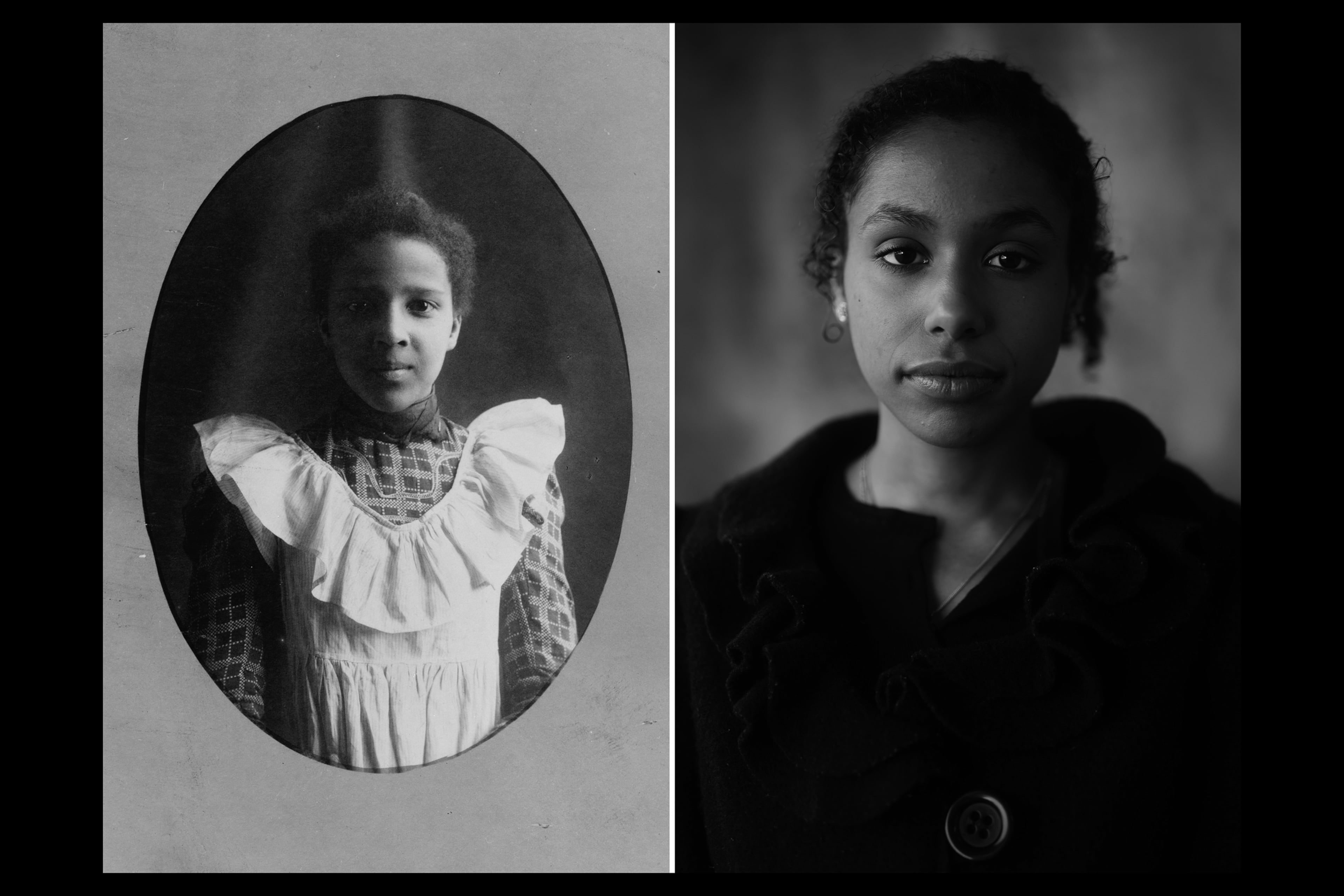
African Diaspora Art Museum of Atlanta revisits the works of W.E.B. Du Bois
New exhibition builds on an The Atlanta Journal-Constitution project to revisit and reinterpret a landmark portrait of Black American life.
LEFT: African American man, half-length portrait. This portrait was amongst the hundreds of images exhibited in W.E.B Dubois’ "Exhibit of American Negroes" for the World’s Fair in Paris in 1900. (Library of Congress)
RIGHT: Fahamu Pecou, visual artist and founder of African Diaspora Art Museum (ADAMA) poses for a photo in Atlanta on Thursday, Jan. 15, 2026. (Natrice Miller/AJC)
More than a century after W.E.B. Du Bois used photographs and data to challenge the world’s view of Black life, a new exhibition at the African Diaspora Art Museum of Atlanta — developed in part by The Atlanta Journal-Constitution — revisits and reimagines his groundbreaking 1900 Paris display, asking what has changed and what has endured.
The ADAMA opening builds on a Black History Month AJC project reported by Mirtha Donastorg and illustrated by Natrice Miller, which revisited Du Bois’ original work. Their data and photography also anchored a recent exhibition at the Clark Atlanta University Art Gallery.
TOP: A portrait of W. E. B. Du Bois, his son Burghardt and wife Nina taken in 1898. In 1900, Dubois presented hundreds of portraits and scenes of Black American life for his’ "Exhibit of American Negroes" at the World’s Fair in Paris in 1900 (Special Collections and University Archives, University Libraries, University of Massachusetts Amherst)
BOTTOM: Julien, Sorai, 5, and Geneley Virgin pose for a portrait in Atlanta on Thursday, Jan. 15, 2026. (Natrice Miller/AJC)
The African Diaspora Art Museum of Atlanta (ADAMA), was launched by artist Fahamu Pecou to showcase local and international artists.
(Left to right) Spelman College students Grace Lisbon, Max Brown, Sanaa Stokes, Nia Simone Wharton and Delaney DeShields sit on the steps of Howard-Harreld Hall on Wednesday, Jan. 14, 2026. (Natrice Miller/AJC)
In homage to Du Bois’ vision of documenting Black American life following Emancipation, “W.E.B. Du Bois Revisited” illustrates how that existence has evolved over the past century.
Using comparative data compiled by Donastorg and images by Miller, the exhibition will open with a panel with the two, joined by historian Karcheik Sims-Alvarado. They will explore how art and storytelling shape social constructs and identity.
During a Paris exposition in 1900, Du Bois showcased his original work “The Exhibit of American Negroes” to articulate the advancement of Black Americans following the abolition of slavery. He chose to correct the narrative, rewrite misconceptions and demonstrate Black progress.
Many of the photographs he used in the exhibit were shot in Atlanta by Thomas Askew.
TOP LEFT: African American man, half-length portrait. This portrait was amongst the hundreds of images exhibited in W.E.B Du Bois’ "Exhibit of American Negroes" for the World’s Fair in Paris in 1900. (Library of Congress)
BOTTOM LEFT: Antonio Mayo, 14, poses for a photo in Atlanta on Saturday, Jan. 17, 2026. (Natrice Miller/AJC)
CENTER TOP LEFT: African American man, half-length portrait. This portrait was amongst the hundreds of images exhibited in W.E.B Du Bois’ "Exhibit of American Negroes" for the World’s Fair in Paris in 1900. (Library of Congress)
CENTER BOTTOM LEFT: Trae’mone Ellison, 15, poses for a photo in Atlanta on Saturday, Jan. 17, 2026. (Natrice Miller/AJC)
TOP CENTER RIGHT: African American man, half-length portrait. This portrait was amongst the hundreds of images exhibited in W.E.B Du Bois’ "Exhibit of American Negroes" for the World’s Fair in Paris in 1900. (Library of Congress)
BOTTOM CENTER RIGHT: Djxani Washington, 14, poses for a photo in Atlanta on Saturday, Jan. 17, 2026. (Natrice Miller/AJC)
TOP RIGHT: African American man, half-length portrait. This portrait was amongst the hundreds of images exhibited in W.E.B Du Bois’ "Exhibit of American Negroes" for the World’s Fair in Paris in 1900. (Library of Congress)
BOTTOM RIGHT: Caleb Murray,17, poses for a photo in Atlanta on Saturday, Jan. 17, 2026. (Natrice Miller/AJC)
In hundreds of black-and-white images the exhibit documented elegant, tailored, prideful Black Americans, opposite of general caricatures peddled at the time in the media.
In February, Donastorg and Miller worked together to re-create that historical moment, to add to the story of how Black American life has continued to fold over the last 100 years.
LEFT: A portrait of Bazoline Usher, a student at Atlanta University taken in 1899 or 1900. This portrait was amongst the hundreds of images exhibited in W.E.B Dubois’ "Exhibit of American Negroes" for the World’s Fair in Paris in 1900. (Library of Congress)
RIGHT: Celia Browning, the great great great grandniece of Bazoline Usher, who was a student at Atlanta University in the early 1900s, poses for a photo in Atlanta on Saturday, Feb. 7, 2026. (Natrice Miller/AJC)
Paying homage to the original exhibit, black-and-white photos of business professionals, families and friends were re-created. Similar photos, similar shots were taken to mirror century-old angles.
Social trends had adapted, but the poised legacy remained.
IF YOU GO
Artist Talk & Opening
6-9 p.m. Friday, April 24. African Diaspora Art Museum. 352 University Ave. SW, Atlanta.
W.E.B. Du Bois Revisited: Reimagining Du Bois’ Exhibit of American Negroes
April 24 — May 2. African Diaspora Art Museum of Atlanta. 352 University Ave. SW, Atlanta.