
Meet the man behind Outkast’s legendary ‘ATLiens’ album art


D.L. Warfield contemplates his options.
Inside of his Alpharetta studio, two cowboy hats are stacked before him, one felt and one straw. The occasion is a photo shoot for The Atlanta Journal-Constitution and UATL.
Warfield is used to making bigger creative decisions. In fact, he’s made a living out of them. But today, straw cowboy hat it is.
As the former creative director of LaFace Records, Warfield helped translate the music and personas of artists including Outkast, Goodie Mob, Usher, TLC, Toni Braxton and Pink into images.
His career has included iconic album covers, fashion and original artwork. But some of his most consequential work came as Atlanta hip-hop was beginning to define itself for the rest of the world.
Thursday marks the 30th anniversary of “ATLiens,” the second studio album from Outkast. When André 3000 and Big Boi released their sophomore effort on Aug. 27, 1996, audiences took notice of its lyrical dexterity and otherworldly production.
But the project also marked a breakthrough for Warfield, who led the creative direction of the album’s now-iconic cover art and visual packaging, which included an Outkast comic booklet.
Warfield’s initial take on the album’s enduring legacy is modest.
“At the time we were so concerned about the moment, and nobody was thinking about 10 years down the road,” he said.
Kid from the Lou
The road to “ATLiens” for Warfield starts in his native St. Louis.
He grew up in North County with a passion for art, sports and animals. A product of the Midwest, Warfield’s creative influences ranged from RUN-DMC and Kiss to “Star Wars” and “Good Times.” A two-sport athlete, he ran track and played football in college while studying art.
After college, he landed a job in the creative department at Tommy Boy Records in New York, home to artists such as Queen Latifah, De La Soul and Naughty by Nature.
New York was a culture shock. Warfield was overwhelmed by the sheer number of people. One of his earliest memories was walking into the office and seeing the late Coolio smoking a joint with one of the label executives.
Then he heard Outkast.
Warfield, now 57, was in his 20s when he heard “Player’s Ball” for the first time.
The sound coming out of Atlanta convinced him something was happening in the city that he wanted to be part of.
“I was like, ‘We got to move to Atlanta and be down there because if those guys are making music like this, this is getting ready to explode,’” he recalled telling his wife.
His only prior experience with Atlanta came during a college track meet at Emory University, a visit that happened to coincide with Freaknik.
But a later trip South for a football workout would prove consequential. While in Atlanta, he reconnected with an old classmate who had music industry connections.
A year later, Warfield got a call to interview for the creative director position at LaFace Records.
He didn’t get it.
Feedback was that he was too young and inexperienced.
Warfield remembers that as a “gut punch.”

What he did next could be considered legendary, crazy or both.
The art school kid kicked in and went about compiling supplies to make a fake bomb. He bought the faux dynamite sticks, clay wiring and steel box. A timer was set inside with a note composed of cut-out letters from magazines. The message, addressed to LaFace Records president L.A. Reid, read: “Hire D.L. Warfield or else.”
Later he got a call that LaFace Records received his message. Warfield got the job.
That Reid told the AJC that he has “no recollection” of the incident only adds to its lore.
The art of ‘ATLiens’
At his new dream gig and new city, Warfield felt at home.
“In New York, you feel like a stranger. In Atlanta, I never felt like that,” he said. “I don’t know if it was because the people, spirit of the South in Atlanta, or maybe it was because of the environment at LaFace.”
At LaFace, Warfield was responsible for all things visual with the exception of music videos, though he did help pen treatments. He was tasked with setting the visual tone of LaFace Records and its artists.
His first big placement was the self-titled debut for R&B group Az Yet.
At work, Warfield gained a reputation as a creative willing to take risks and push artists. His co-workers took notice.
Sheri Riley remembers an early team meeting led by Reid. Plans for Outkast, Toni Braxton and Usher were being discussed. As the senior director of marketing, she tirelessly took notes, and Riley watched Warfield doodle in a sketchbook. She was appalled.
Afterward, she took a peek at Warfield’s drawings. He had turned the meeting’s key points into sketches. That’s when it clicked for her.
“I immediately said to him, ‘Ah, I get it now,” Riley said. “We think in words, you think in pictures.’”
That ability to turn ideas into images would become Warfield’s calling card at LaFace.
Riley also remembers a self-taught whiz who figured out how to use the office’s first computer after reading its 1,000-plus-page manual.
These were small feats. His biggest opportunity would come from a group still fighting to establish the South’s place in hip-hop.
When he arrived at LaFace, Outkast and Dungeon Family were readying their next move after Andre 3000’s, “the South got something to say” boast at the 1995 Source Awards.
There was a feeling they still needed to prove themselves to hip-hop die-hards above the Mason-Dixon Line without getting adversarial.
“We were more like, ‘OK, understood. Y’all didn’t get it yet. So let us give it to you in a way that you can understand it without having to change who we are,’” said Kawan “KP the Great” Prather.
Prather worked as A & R at LaFace in addition to being an artist and Dungeon Family member with the group Parental Advisory (P.A.). He relayed what André 3000 and Big Boi were trying to convey.
“Everybody looked at each other as foreign. So we understood the alien part of it. We understood why it felt so different,” Prather said.
As the youngest staffers, Prather and Warfield clicked early. Two kids from different towns who bonded over their love for hip-hop.
Prather shared notes from Andre 3000 and Big Boi with Warfield.
“It wasn’t like I had to do much because D.L. understood it because he was from it. He understood what it meant to have a superhero Southern comic book,” Prather said.
That mattered. Warfield wasn’t being asked simply to package Outkast’s music. He was being trusted to visualize a Southern Black identity that the group believed much of hip-hop still misunderstood.
“We wanted Dre and Big to be happy and Organized Noize to be happy,” he said. “We wanted them to be dope so they can talk to the guys at Wu-Tang and be like, ‘Yo, look at what we got.’”
What they got was true rap superhero ethos without it looking cheesy.
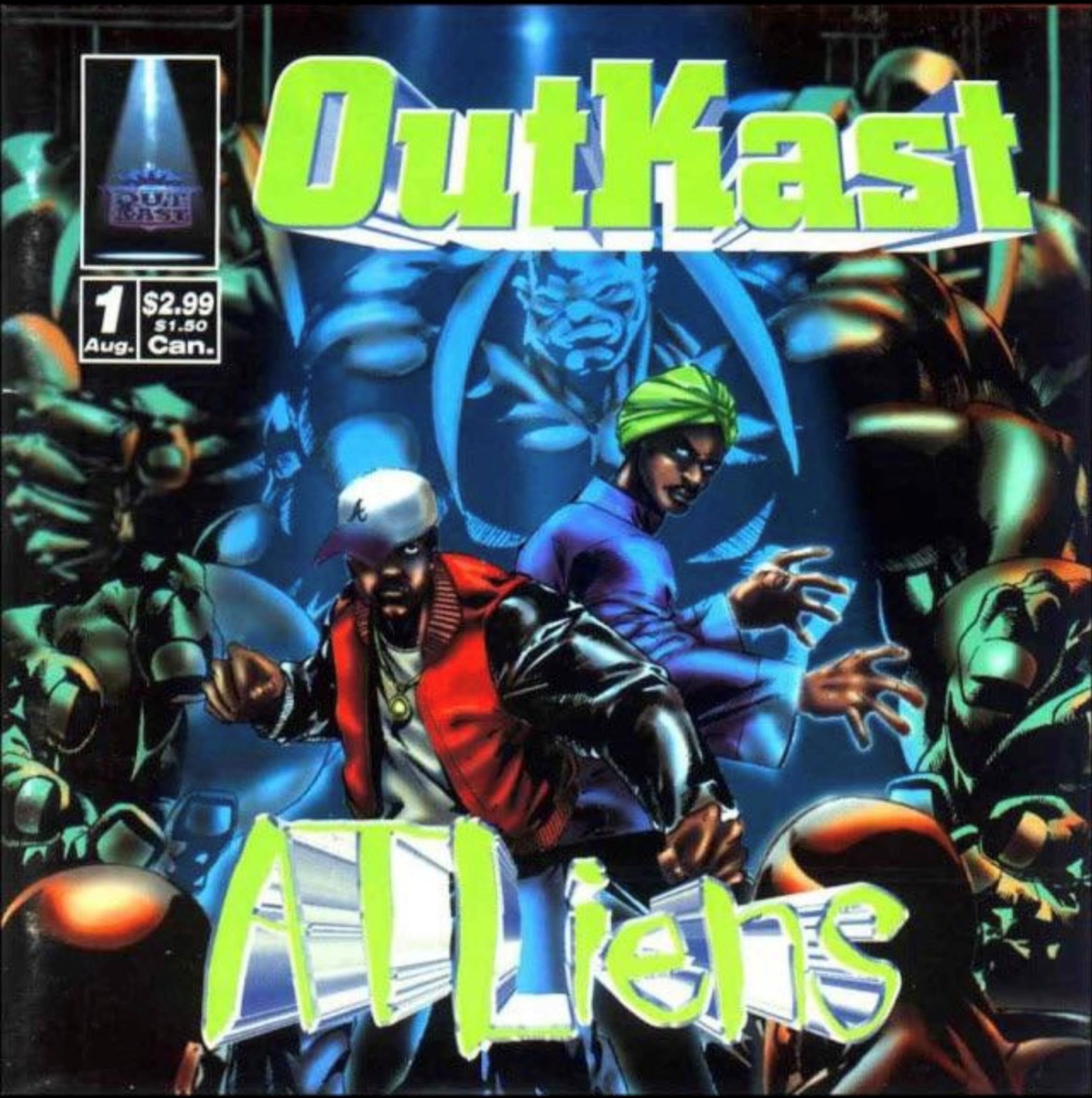
There stood Big Boi and André 3000, ready for battle. Behind them, the outstretched arms of some evil forces. The blue, green and black color palette with its central figures reaching out to the consumer gives a feeling of Afrofuturist Avengers.
The actual storyline for the comic was written by Dungeon Family and spoken word artist Big Rube. At the time, Warfield remembers them all reading the conspiracy novel, “Behold a Pale Horse,” so their discussions around the text and brainstorming notes inspired Rube’s narrative.
Over time the album would go on to be double platinum, cementing Outkast as formidable artists and budding producers. By name alone, it gave legions of listeners in and outside the perimeter a calling card.
“That he was able to take their idea around ‘ATLiens’ and really come back with a visual that represented what they wanted to do, what they did musically, what they talked about — that was so much him, the idea, the concept,” Riley said.
For Warfield, the process always begins with the music.
“I would ask them how do they want people to feel when they pick their album up at Tower Records? What do you want your fans to feel like?”
“Dre and Big, they lived it,” he said. “So if it wasn’t for the great music, it wouldn’t have mattered.”
That ability to translate an artist’s identity into a visual language would become a throughline in Warfield’s career. A few years after helping Outkast present its vision of the South to the world, he would do it again for another young Atlanta rapper intent on defining himself: T.I.
The ‘King’ and T.I.
Warfield worked with T.I. on his 2001 debut, “I’m Serious,” helping establish the visual identity of the young rapper who would soon declare himself the “King of the South.” Twenty-five years later, Warfield was there for the final chapter of that story, serving as creative director for T.I.’s final album, “Kill the King,” released in June.
Warfield remembers meeting a young T.I. who carried himself like a star without being arrogant. Now, he jokes about “all the zeros he’s been able to add to the back of his name.”
For “I’m Serious,” Warfield wanted to evoke the 2000 film “Gladiator,” positioning T.I. as a street version of Russell Crowe’s Maximus.
“I really wanted to just have the composition be more confrontational like him against the world,” he remembers.
They ultimately landed on a black-and-white photograph of T.I. standing on a street in Bankhead, where he grew up.
For “Kill the King,” Warfield and T.I. moved in the opposite direction, choosing not to feature the rapper on the cover. The artist who had spent much of his career embracing the “King of the South” moniker was now using his final album to dismantle the ego behind it.
The contrast between the two projects is striking. Warfield’s first visual concept for T.I. was about establishing the young rapper’s presence. The last dismantled the persona they had helped build.
That it was Warfield who saw T.I.’s final album through made sense to Prather.
“I think the fact that he’s unapologetically Black and having that as a throughline helps in the trust of other Black artists and them freely expressing themselves to him to be able to translate it,” he said.
No slowing down
The conversation in Warfield’s Alpharetta studio winds down. He’s reflecting on “ATLiens” and his career — including the defeats, like failing to convince Toni Braxton to go with a Nefertiti vibe for her certified diamond album, “Secrets.”
The conversation shifts to family and legacy, and the former college athlete reaches for a sports analogy.
“I’m on the back nine,” he says.
His kids are used to growing up with drop-ins from Usher and André 3000. Whether his kids fully understand their father’s place in Atlanta music history isn’t something they talk about much.

As a coach, he’s mentored current NFL players, college blue chips and his son who plays at the University of North Alabama.
If his recent work is any indication, Warfield’s version of the “back nine” doesn’t look much like retirement.
He collaborated with the Atlanta Falcons for their Hip-Hop 50 celebration.
His AmericanFlagRemix series unveiled a new piece, “The United States of Power for the People,” timed to America’s 250th anniversary. His daughter served as a writer and director for an accompanying documentary narrated by rapper Black Thought.
The AmericanFlagRemix series, examining the multiple ways we view and engage with patriotism, is one he hopes to turn into an exhibition. Same goes for his “Cyphers” series, showcasing large-scale circular pieces.
For all the places “ATLiens” took Outkast, Warfield sees something of his own underdog story in the album’s creation.
“It was just like one of those moments where you believe in something, and the distractions don’t matter. What people say doesn’t matter,” he said. “You’re really doing it for the creative integrity.”