
Let Me Put U On: To the ‘Jesus Saves’ sign watching over Atlanta

Auburn Avenue is my favorite street in Atlanta. Period.
In nearly 30 years of covering race and culture in this city, I have spent countless days on what was once known as the “richest Negro street in the world.”
It is where I walked to the old SCLC offices to hang out with the Rev. Joseph E. Lowery and the gentle giant James Orange. Where I watched the congregation of Ebenezer Baptist Church march from its historic sanctuary into a gleaming new one. And where I first met Coretta Scott King, still one of the most awe-inspiring moments of my career.
My first Atlanta barbershop was the Silver Moon, then billed as the “Oldest Black Shop in Atlanta: Since 1904.”
It’s long gone now.
These days, when I need an edge-up, I go see Mr. Junior at Burden’s Barber Shop, tucked along the back of the Prince Hall Masonic Temple.
Some of my favorite nights on Auburn were spent at Pal’s Lounge, where Fahamu Pecou, Fabian Williams, Errin Haines, Kimberly Binns, Kimberly Stewart-Lucas and I ruled the city as the Karaoke Disciples, the baddest and funkiest karaoke troupe Atlanta has ever known.
We were younger then and all trying to figure things out. Careers. Relationships. Who we were and who we wanted to become.

Friday nights on Auburn gave us a few hours to forget about all of that. We grabbed microphones, sang loudly, laughed even louder, cried and, for a few hours, ruled the city.
We had no idea where life would take us.
Today, that circle includes doctors, lawyers, college professors and organizational leaders. Globally renowned artists and media figures. We grew up.
Auburn Avenue changed, too. Businesses opened and closed. Buildings disappeared or found new lives. The people and energy of the street shifted.
But on those late Friday nights walking out of Pal’s, there was one thing I could always count on.
I could look up.
High above Auburn Avenue, glowing from the steeple of Big Bethel AME Church, were two words that had watched over the street for generations:
JESUS SAVES.

I can’t remember the first time I saw the Jesus Saves sign, but I know I have been drawn to it since I moved to Atlanta in 1997.
Maybe it is the simplicity of it.
Maybe it is the way you can see it from blocks away. Or maybe, especially during those years when so many of us were trying to figure out what came next, it was the reminder that there was still hope.
By the time I got here, Big Bethel AME Church was already 150 years old. Founded in 1847, it is Atlanta’s oldest Black congregation.
Its history is intertwined with the city’s. In 1879, the Gate City Colored School, Atlanta’s first public school for Black students, opened in Big Bethel’s basement. Two years later, Morris Brown College was founded in that same basement.
I don’t have a church home, but I have always loved Big Bethel.
I love the majesty of the building and the history contained within its walls. I love sitting in its pews each year to watch “Heaven Bound,” the musical pageant and morality play that has been performed there since 1930.
I love the fun fact that the grand exterior of Big Bethel served as the Sons and Daughters of Shaka lodge in the 1975 Bill Cosby-Sidney Poitier classic, “Let’s Do It Again.”
I love what Big Bethel represents to Auburn Avenue and to Atlanta.
And I love that sign.

There is something about the gospel, and the simple promise contained in those two words, that still moves me.
JESUS SAVES.
But the sign has its own Atlanta story.
In 1917, a massive fire swept through the Fourth Ward, destroying much of the neighborhood east of Boulevard. Big Bethel was the only Black-owned church in the ward left standing.
Three years later, fire struck Big Bethel itself. Making matters worse, the church’s insurance policy had expired just one day earlier.
Undaunted, the congregation rebuilt. Black architect John Lankford helped transform the church from its Victorian design to the Romanesque Revival landmark we know today.
And high above Auburn Avenue, the rebuilt church was crowned with something new: a lighted cross bearing two words.
JESUS SAVES.
During my years in Atlanta, I’ve had the great fortune of writing the obituaries of some of the city’s most prominent figures, as well as people who quietly helped build and shape the city.
In 2019, one of those obituaries led me to a man everybody called “Big Mike.”
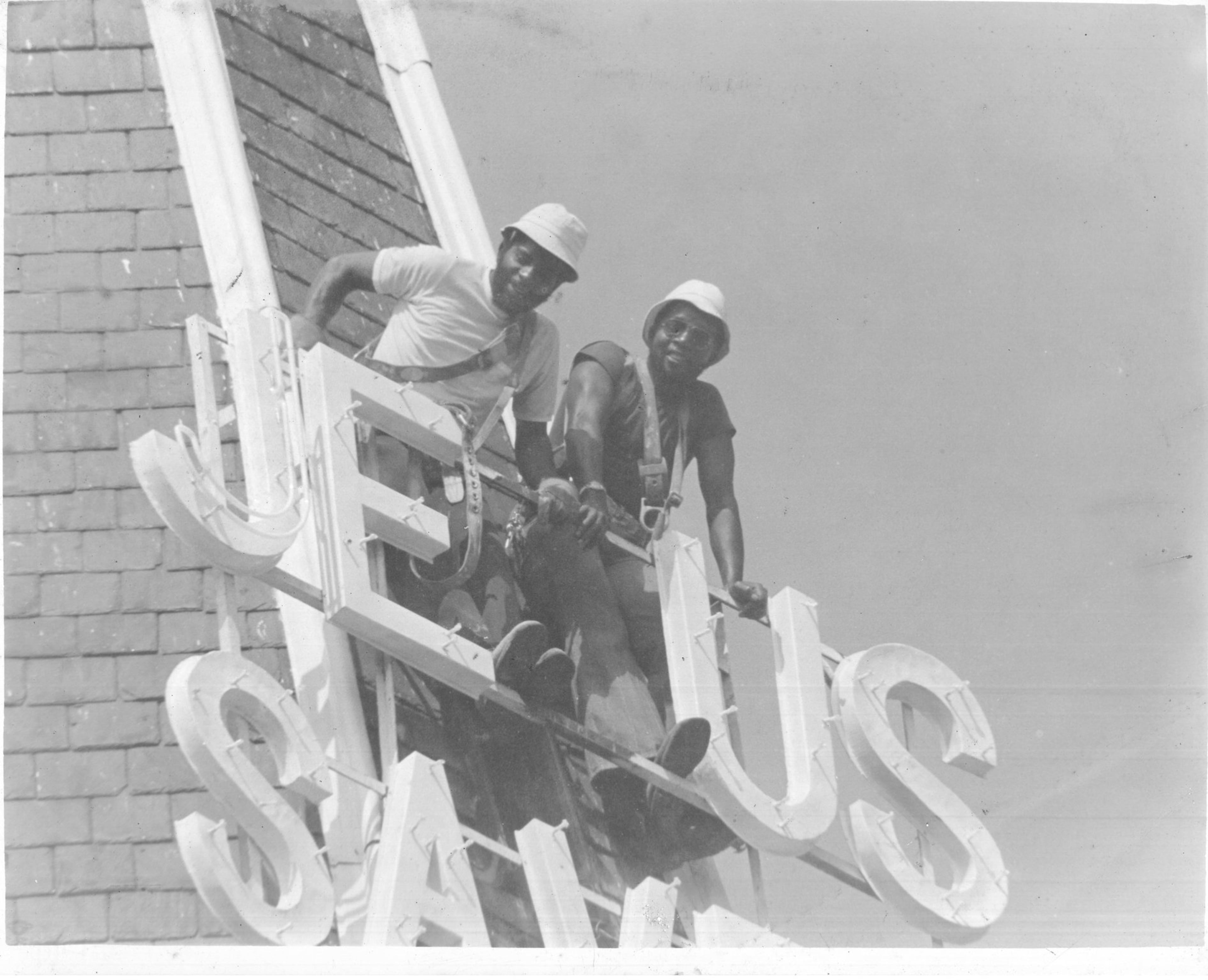
William Henry Stanford served in Vietnam, worked as a police officer and private detective, and eventually started a construction company with his brothers.
And in 1979, Big Mike, who grew up in the Fourth Ward, got one heck of an assignment.
The Jesus Saves sign was falling apart. The structure was rotting. Birds had broken much of the neon.
Big Bethel called Big Mike and his brother Jerry Stanford to restore it.
They had a cousin make the letters. A sign company made the neon. Then the brothers hoisted themselves by rope up the roughly 200-foot steeple and installed it.
“When I was younger, I would say my daddy put that sign up,” Stanford’s youngest son, Jerrol Stanford, told me. “Even today, it gives me comfort to drive past it.”
JESUS SAVES.
Auburn Avenue will keep changing. Buildings will come and go. Businesses will open and close. People will move on.
But there is comfort in knowing that some things endure.
When I’m on Auburn Avenue, I still look up.
JESUS SAVES.
